Vote for Policies

Vote for Policies is a site that aims to extract party policies from the personalities and rhetoric of the surrounding campaign and lay them out next to each other so voters can really focus on the issues that matter to them. They claim it helps make “an informed, unbiased decision about who to vote for” for those who might want to vote with their head as much as their heart.

How it Works

A simple survey allows voters to compare policies for issues they select. At the end of the survey the results will show which party’s policies you most agree with both overall and broken down by each issue. You can also see the overall results for your constituency.

How it is Funded

The site is run by volunteers and aims to be neutral and objective. It is funded using crowdsourcing via donations. It was created for the 2010 General Election and over 500,000 surveys have been taken so far. For the May 2015 General Election they are aiming for over 5,000,00

Trying it Out

It’s worth noting that presently the site remains the one created for the 2010 election. This means the policies are not current and the parties represented do not represent current developments of the major Scottish, Welsh and Northern Ireland parties. The site is being updating for 2015 and a new mobile friendly version with updated policies and parties is due in February.

I decided to try the current version out to see my current starting point and outlook based on the 2010 policies.

I tried out every issue and at the completion of the survey my doughnut chart revealed I was 44% Labour, 33% Green and 22% Liberal Democrat. This isn’t really surprisingly as it reflects many of the starting views I’ve outlined and accurately reflects how I voted at the last election and elections since then.  This is where I would expect to be or at least to have been in 2010.
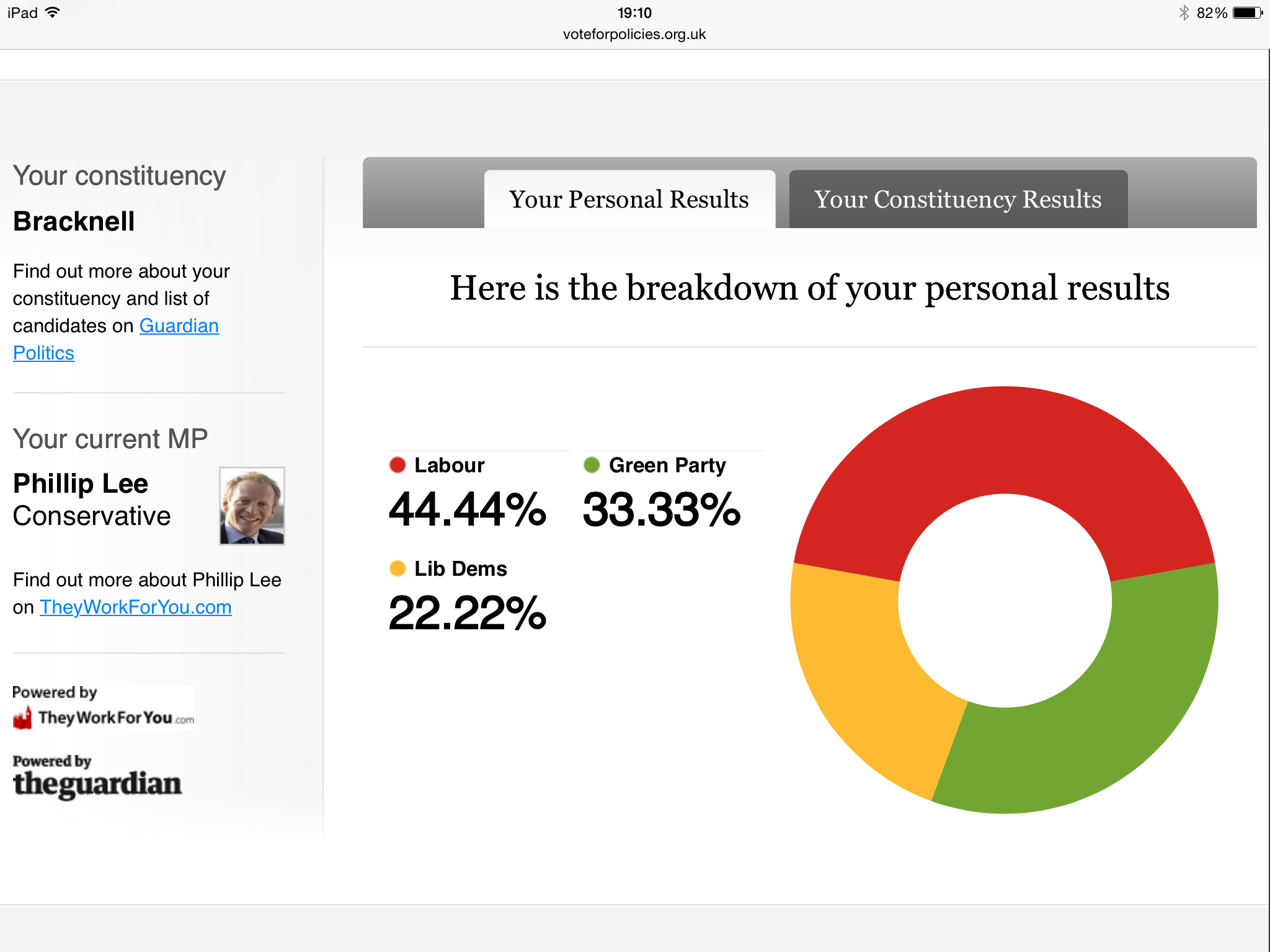
2015-01-18 19.10.07This is not too dissimilar to my constituency picture with Labour, Green and the Liberal Democrats followed by the Conservatives and UKIP.

2015-01-18 19.10.18Which is nothing like how the constituency voted in 2010 or indeed in my living memory.

Source: Guardian

Source: Guardian

What Does this Tell Us?

It is not surprising that leftist advocates will happily point to vote for policies as a better way of deciding on your vote. The overall position consistently puts the Greens, Labour and the Liberal Democrats ahead and recently the Greens have surged. Many suggest this is indicative of the current green surge and whilst I’d like it to be so I’m not sure about using the data so uncritically. The picture for my constituency is totally at odds with what happened.

Some possible reasons for the difference and reasons to use Vote for Policies with caution include:

  • voters only discovered Vote for Policies after the 2010 election and had they had tools to help them separate the policies from the personalities they may have voted differently?
  • Vote for Policies is seen as interesting but mostly a bit of fun and established media and campaigns have much greater influence in voter decisions.
  • The sample size is small. Vote for Policies didn’t reach that many people previously but may play a bigger role in the coming 2015 election.
  • An online tool like this appeals only to a minority of voters in certain demographics. There is no demographic breakdown for the constituency or overall responses. Those advocating the tool are likely to be tech-savvy, media literate and used to obtaining their information from diverse sources. Do these really represent the core voters who turn out and decide elections?
  • The algorithm for calculating scores is only simply described on the FAQ page and is quite simple. Is this kind of averaging the best way to represent choices.
  • As far as I can see there is nothing to prevent people ‘gaming’ the system.
    • In some cases it is blatantly obvious which party is which. The policies are compiled without editing except to remove party names. This is admirable as editing brings its own problems but different parties have quite distinctive language. Their rhetoric is still discernible in their policies even out of context. More neutral language would make it harder to distinguish part policies by their language. Given this someone could go through and simply vote for the policies they recognise from their party rather than make an “informed, biased choice”.
    • There is nothing as far as I can see to stop people completing the survey multiple times to influence the results.

I also found it interesting to note that not everyone taking the survey is examining every issue. The issues that voters are selecting may tell us something about priorities with Health/NHS top with 404.2K votes followed by Education (392.1K) and the Economy (379.6K). Europe is least voted on (258.6K) so perhaps these agonised debates about the European Union have undue prominence. Bearing in mind the caveats above there are still little vignettes to chew over such as the Liberal Democrats leading on Democracy and reflecting on the possibilities for democratic reform they have squandered this parliament.

Going Forward

Whilst I want the Vote for Policies outcomes to be truly representative of how people would vote if they focused more on policies I am concerned that it’s not enough to hold up data that reflects your point of view and use it uncritically as a campaigning tool.  Despite the prominence given to overall results on the site I’m also not sure this is the intended use of the tool.
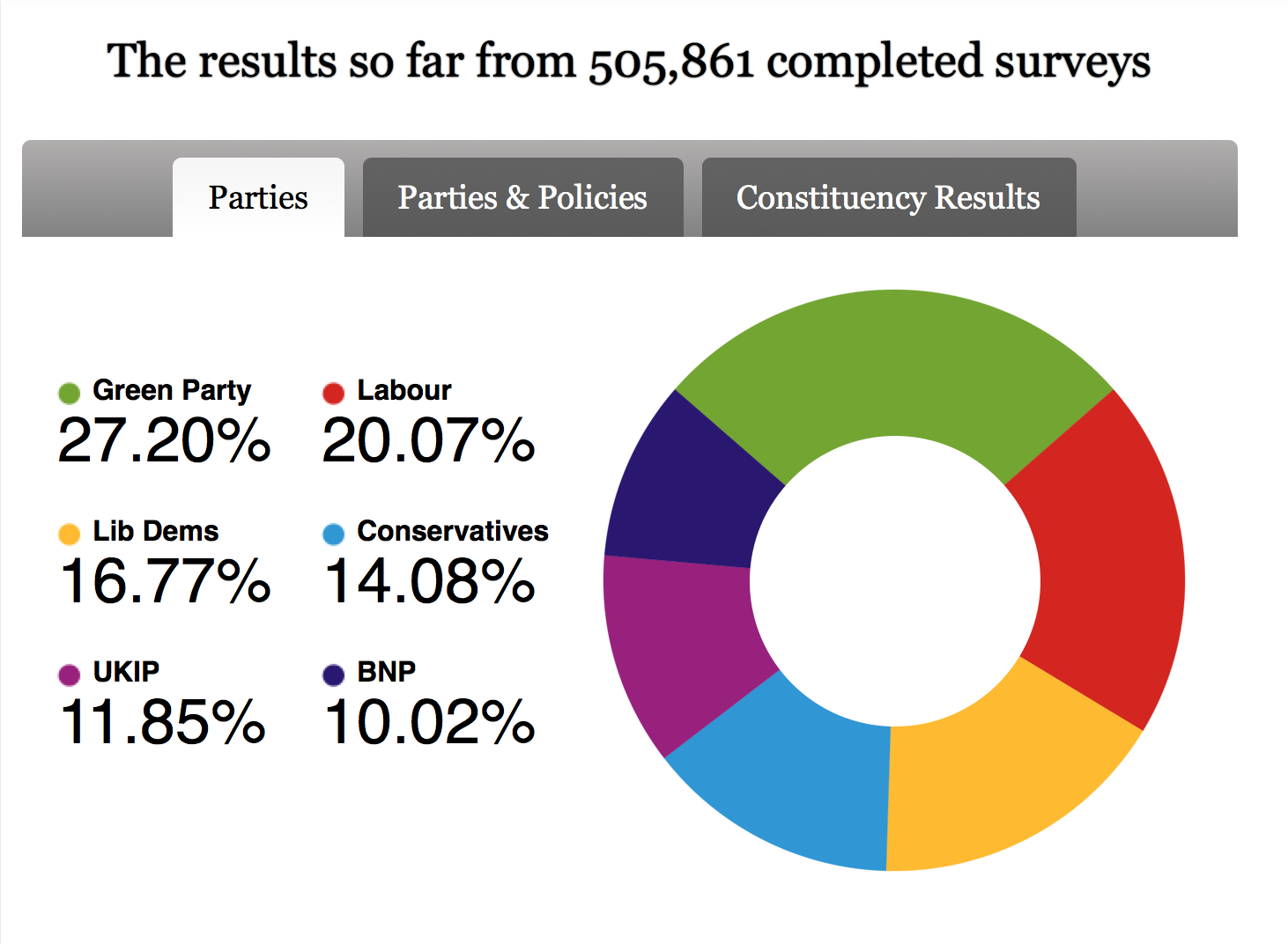
The current Vote for Policies results.  It looks good for the left but how representative is it?

The current Vote for Policies results. It looks good for the left but how representative is it?

There are too many caveats and questions about how the data is compiled. If Vote for Policies are hoping to be more powerful this time around, or at least tolerate use of their data for campaigning, they might need to address some of these and be more transparent about their data and maybe even open it up. Certainly if multiple survey completions by the same people can’t be prevented the data isn’t that representative generally and those using it as a kind of opinion poll should do so with caution.

Where Vote for Policies works best is in the particular: as a useful tool for individuals that aids the engaged voter review, compare and contrast all policies on a particular issue in one place.

Despite my reservations I do appreciate all the work the team behind Votes for Policies are putting in to help present information differently and making it simple and clear for voters to compare parties on key issues. I am looking forward to seeing how they refresh the site and the policies over the coming weeks.

I will take the survey again once it has been revised to see how my views change and to critically appraise the update. I’ll also continue to keep an eye on the overall data and how people use both the tool and data during the campaign.

Some Starting Views

It should be obvious that my starting position is on the left political wing. I am a social democrat. I instinctively believe things the Left represent and in a reformist, slightly radical but not not revolutionary approach to achieving them.

Most people have a complex relationships with the political spectrum.  You can support policies that come from a range of parties.  Philosophically a key dimension of the political spectrum is the tension between the common good and individual good.  Everyone wants what is best for themselves but how far are you willing to pursue this if it means harming others?  How much should individual’s compromise in order to achieve a shared basic social compromise?  These are some of the big questions that peek from behind the policies.

Filters and Lenses

Some of the things I believe in are:

  • I believe that we need to pay more attention to the environments and ecosystems we live in if we are to provide sustainable security for all.  Not just in the short term but the security that comes from believing these things will exist in the long term.  This is welfare in the large not the narrow-minded definition of welfare we’ve turned it into.  Sustainable security comes from:
    • having physical safety
    • having enough food to eat
    • having warmth and shelter
    • being healthy
    • having fulfilling work that receives respect and fair remuneration or benefit in kind
    • having access to education
    • having the opportunity to be active member of a community.
  • I believe mostly in pluralism and consensual approaches to increasingly complex problems.
  • I believe it is my patriotic duty and moral responsibility to make a shared contribution to the governance and infrastructure of this country.  Pooling our resources makes the country better and safer for all of us and provides important protection for those in need whether they are businesses or individuals.  We all have a responsibility to contribute to social and charitable provision as well as meet our individual needs and should do so for as long as we are able.
  • I think governments and politics need reforming but I also think that marketplaces need regulating.
  • I don’t think public or private are inherently better than the other.  All large, old complex organisations have issues and both public and private organisations have important contributions to our society.  Neither one should be vilified in general but should be innovated and improved in the particular.
  • I prefer the word we to them.  Every time debates reduce an issue to “them and us” it has grossly over simplified a problem and closed off many potential solutions.  I find it hard to think of scenarios where we don’t all have some responsibility for problems or ability to contribute to solutions.
  • I believe people should be paid a fair wage for a fair days work. That should be at least the legal minimum and the legal minimum should be a living wage.
  • I believe in individual freedom and individual responsibility but I also believe neither is absolute and governments exist to support the greater good. I think governance should be by many for many not by few for few.
  • I believe most strongly in the [universal declaration of human rights](http://www.un.org/en/documents/udhr/).  This emerged from the darkness of war in the middle of the twentieth century and whenever I read it I think yes, this should guide us towards a sustainable future that ensures a better life for more people.

Voting Green 2015

At the moment my current voting intention in the UK 2015 general election is to vote for the Green Party. I’ve been a Green member for several years without being terribly active about it.  I have mostly voted Labour all my life and was born into a strong Methodist, Socialist tradition.  However, I think it is important that we have greater choice if politics is to continue being meaningful to people going forward.  We should have 5 major parties in each constituent country and a vote for the Greens will make it clear that there is greater energy and diversity in than country’s left wing than First Past the Post tactical voting demonstrates.

That’s not to say I am lost to Labour.  They just have to get off the fence and do better.  Not in their policies but are usually better than the mediated interpretations give them credit for.  No, the Labour party need to stop hedging their bets and tell better, more persuasive, more seductive stories about the power of social democracy.

To be honest I don’t think this is a great election to win.  We have yet to reach rock bottom in this crisis and the full social effects of the austerity cuts to public services have yet to be felt in full.  Better perhaps that they should be revealed under those who instigated them rather than a left wing coalition be caught in possession.  My wish for May 2015 is that another Conservative led coalition or minority government forms narrowly sneaks in the face of a diverse left surge (featuring Labour, Green parties, SNP, Plaid Cymru) and staggers on until the nadir is reached and a no confidence vote is able to trigger dissolution.  The left will hopefully be bold enough to finally seize its social democratic moment over this crisis and won’t be caught in a position where they will be too easily maneuvered into being responsible for austerity outcomes.  We can but dream.

Asking Questions

However, this is my starting point.  I don’t want my views to be fixed or dogmatic.  Yes I will be using the blog to advocate for more left wing politics but I also want to use it as a space to genuinely interrogate modern UK politics both the policies and bigger philosophies were are grappling with and being asked to choose between.  Most political party philosophies have faded from view as the technocratic demands of governance take over.  Most were formed in order to practically implement  strongly held philosophical beliefs.  Gradually these have been eroded into the corporate platitudes of modern politics.  One of the things that attracts me to the Green Party is it has a published philosophical basis that is both visionary and humble.

I think the biggest asset you can have in the world is an open and inquiring mind. Whilst I won’t be able to get away from the fact that my background and beliefs will always filter politics for me towards a certain bias an important aspect of civic participation is listening to the perspectives of others and attempting to understand views that aren’t your own.

Society is made up from all sorts of people and so a balanced view means taking account of all sorts of opinions.  Of course I’m going to be more lenient towards left wing ideas and more critical of those further to the right but that’s why there are all sorts of other people with their blogs out their arguing the opposite.  That is pluralism.  That is politics.

Misgivings

I also want to write something about why I haven’t been obviously and actively political; why in fact I’ve been put off.

It’s an awful thing to say but I’m actually scared.  Yes that’s right in a modern, democratic country as citizens and leaders stand up for freedom of speech in the face of horrific violence I’m scared to say something meaningful because I’ve seen that women (and indeed men) having and articulating opinions, possibly contentious opinions,  in public fora attracts abuse ranging from the patronising to the disgustingly violent.

Personally, I am more fearful of the boorish and bullying trolling that passes for public discourse and online debate in this country than I am of terrorist attack or ‘Sharia law taking over my country’. My country is already full of anti-social, vicious people shutting down views that don’t conform to theirs. Is this the freedom of speech we are defending?

I do occasionally fear acts of terrorism and vicious criminality but no more today than I did as a student in London in the 90s wondering where the IRA may strike or maybe a nail bomber who is not a fan of minorities. No more than I fear travelling home on a train later in the evening.

Yet as a mature, capable, intelligent, homosexual woman in 21st century Britain I do increasingly think

“actually I don’t want to put myself in a position where people seem to think it would be perfectly acceptable to sneer, bully, threaten and abuse me just for having an opinion or being a bit different. Why bother?”

That’s apathy based on fear of my ordinary fellow citizens not foreign extremists. The risk of me suffering a fatal terrorist attack is utterly unpredictable so I fear it less; the risk of me encountering distempered debate and personal abuse seems utterly predictable so I fear it more and am more altered by it.

People will say it’s not the same. Angry trolls respond with verbal barbs not guns; men who ask if you want to have sex with them on the train aren’t so scary; murderous ideologues are the only bad guys to fear because they are the worst. But that’s what terrorism is about isn’t it? Using fear in order to influence the behaviour of others not the actuality? Such relativism is a taxonomy of criminality, deviance from legal codes, not a measure of fear. Extremism’s very sensationalism makes it both more shocking and less likely than the more petty acts that insidiously feed my anxieties. I fear them all.

So yes, I’ve been practicing a form of self-censorship as an act of self protection.  Then you reflect on people who are brave enough to stand up for what they believe in the face of violence and horror I cannot imagine and you realise, as many others have done before, that the insecurities of bullies will never be assuaged by appeasement.

My failure to participate becomes part of the failure of the Left, a failure of social democracy, a failure of pluralism, a failure of achieving a human civilisation that is safer and fairer for all and, failure to prevent unnecessary damage to the rich and precious ecosystem of our planet.

You have to be part of public debates if you want to change things however uncomfortable, difficult and even tedious at times that may be. I have to hope that talking about the world with others will turn out to be more polite, respectful and thoughtful than I fear.

Why Write a Political Blog?

Simply because I wanted a space to engage more, think more and write more about social democratic politics. Because I want things to be different and that’s not going to happen unless people make it so.  I believe, rightly or wrongly, that the current parliament has been regressive for the country.  I think the left are better at managing the economy than common mythology has allowed and their policies are more effective than they have been given credit for.

Telling Stories

That is because politics is less about facts, less about the practical realities of ordinary lives and more about the subtle arts of persuasion: of being skilled at telling sublime stories, modern myths and the subtle rhetoric of making true become false and false become true.  It’s frustrating if you want politics to be about facts because political discourse allows for no such thing.  The facts are never allowed to speak for themselves and lies are encouraged to flourish.

Instead you find yourself in a world where the 2008 financial crash is said to be caused by those who were least involved and have been punished mostly harshly by the outcomes.  You find those who gambled unwisely and took all the rewards carried no risk after all and continue thrive.  You see those who provided the assets to prop up the financial sector roundly criticised for their profligacy.  We will never know how a different government would have handled 2008 and what they would have done instead.  We will never know how an economy that was already recovering in 2010 would have mended under a different government to the one we got in 2010.  We do know the myths that have taken root to justify the blatant asset stripping of our state and subjugation of public sector and low paid workers.

It is not enough to act.  It is not enough to cry unfair at blatant manipulation of the public record.  It is not enough to complain about the Fourth Estate without leveraging social media in response.  The left needs to find its voice and  add intellectual weight and articulate stories itself to advocate and argue for what the left does.

Terrorism, Critical Theory and Politics

Then there was the horrific criminal attack on the offices of Charlie Hebdo. The small-minded but deadly violence of that assault and related attacks was atrocious.  Such blatant acts of violence and criminality are easy to condemn.  There is no place for such assaults in our world.

The debates about freedom and responsibility that have been unleashed are harder to comprehend and form a position on.  I have read many words about these attacks since that awful day in Paris and no doubt there are many more to come.

Some represent extremist views from the full spectrum of political and philosophical dogmas but others have been complex and more nuanced. It’s been worrying how easy it’s become to use this assault on free speech to shut down divergent views and open debate with variants of the line “ah but whatever our faults we don’t react with an AK47”. Whilst true, this kind of absolutism disallows any form of self-reflection, critical thought or opportunity for any of us other than the perpetrators to reform.  The terrorists are not winning but neither are the disenfranchised.  There are unfortunately no easy and simplistic answers to many of these questions.

I do know that to paint Western society as entirely perfect and liberal and Muslim society as entirely barbaric and conservative is the most ridiculously simplistic answer of all. All societies have their benefits, problems and violent outliers to different degrees. Different times suffer different wars. In our time many conflicts connect to Islamic insurgents though others don’t. I don’t pretend to understand the complexity of it all.

One article in particular stuck with me and that was by Slavoj Žižek in the New Statesman

In it he said:

“it is the right moment to gather the courage to think

He traces the faultlines or violent, radical Islam and liberal Western responses through critical theory finally settling on Walter Benjamin to tie the failure to mobilise dissatisfaction in more constructive progressive ways to a failure of the Left to lead that way.  Instead conservative voices, opportunist demagogues and violent radicals are seizing on dissatisfaction full not just of “passionate intensity” but also passionate insecurity.

Now you may not agree with his argument that the difference between permissive liberalism and Islamic fundamentalism is but the latest false dichotomy: false because they are both reactions to the same dissatisfaction and reactions to each other.  They cannot exist without each other.  You may also not agree with his view that “those who do not want to talk critically about liberal democracy should also keep quiet about religious fundamentalism”.   I however don’t wish to tolerate radical Islam but nor do I wish to use its presence as an excuse to avoid taking a critical look at my own society.

Failings of the Left

It’s all too easy to react furiously and to blame others if the world is not as you would like it but the first thing to do is examine yourself before tackling the incomprehensible. Change can only and always start with yourself.

The rise of fundamentalist, perhaps violent, ideology of any variety will fill a vacuum left by the failure to offer any credible response to people who, rightly or wrongly, feel like they have a raw deal.

It’s hard for me to say it but since the post-WWII settlement I think the radical, reformist Left’s intellectual hinterland and it’s political appeal has been slowly seeping away.

The failure to change anything, anything, following the 2008 financial crash and the ability of others to turn that narrative into one of state spending culpability justifying unnecessary austerity and a vicious ideological slashing of the state that is iniquitous and damages whole swathes of our society is as big a defeat for social democracy as I’ve lived through.

I stood by and let it happen.

It should be impossible for any left leaning pluralist to ignore the siren screams of discrimination, corruption and violent crime.  We won’t all participate in Politics on a grand stage but that doesn’t been we should abdicate our responsibilities to participate in our politics locally and/or and join debates about what is a better society, what is sustainable living in order to build it from the ground up. I believe that society and that lifestyle comes from social democratic politics so I should stand up for that.

Stand Up and Be Counted

The analysis on major parties by Ofcom showed that nor is it is not enough to have an opinion. You have to have an obvious and measurable opinion in the hyper mediated world. You don’t just have to stand up you have to stand up and be counted.

Their analysis of current support uses only opinion polls not party membership. Their analysis of elections considers not just elected representatives but share of the vote. If that is the case then protest votes and tactical votes become invisible. No vote is ever wasted if it means more media recognition that alternatives exist and people are willing to vote for them. That told me it was not enough to be against what I disagreed with but I had to more obviously and actively be for what I believe.

I certainly don’t agree the answer to disaffection with politics is to turn your back on it and not vote. If you don’t like it you have to do more. You can’t complain that all politicians are the same if you aren’t willing to represent difference.

All this led me to believe, despite my misgivings, I should do something, however small, to be a more democratic and engaged citizen and to represent and advocate social democracy in public discourse. So this is a start.