Vote for Policies is a site that aims to extract party policies from the personalities and rhetoric of the surrounding campaign and lay them out next to each other so voters can really focus on the issues that matter to them. They claim it helps make “an informed, unbiased decision about who to vote for” for those who might want to vote with their head as much as their heart.
How it Works
A simple survey allows voters to compare policies for issues they select. At the end of the survey the results will show which party’s policies you most agree with both overall and broken down by each issue. You can also see the overall results for your constituency.
How it is Funded
The site is run by volunteers and aims to be neutral and objective. It is funded using crowdsourcing via donations. It was created for the 2010 General Election and over 500,000 surveys have been taken so far. For the May 2015 General Election they are aiming for over 5,000,00
Trying it Out
It’s worth noting that presently the site remains the one created for the 2010 election. This means the policies are not current and the parties represented do not represent current developments of the major Scottish, Welsh and Northern Ireland parties. The site is being updating for 2015 and a new mobile friendly version with updated policies and parties is due in February.
I decided to try the current version out to see my current starting point and outlook based on the 2010 policies.
I tried out every issue and at the completion of the survey my doughnut chart revealed I was 44% Labour, 33% Green and 22% Liberal Democrat. This isn’t really surprisingly as it reflects many of the starting views I’ve outlined and accurately reflects how I voted at the last election and elections since then. This is where I would expect to be or at least to have been in 2010.
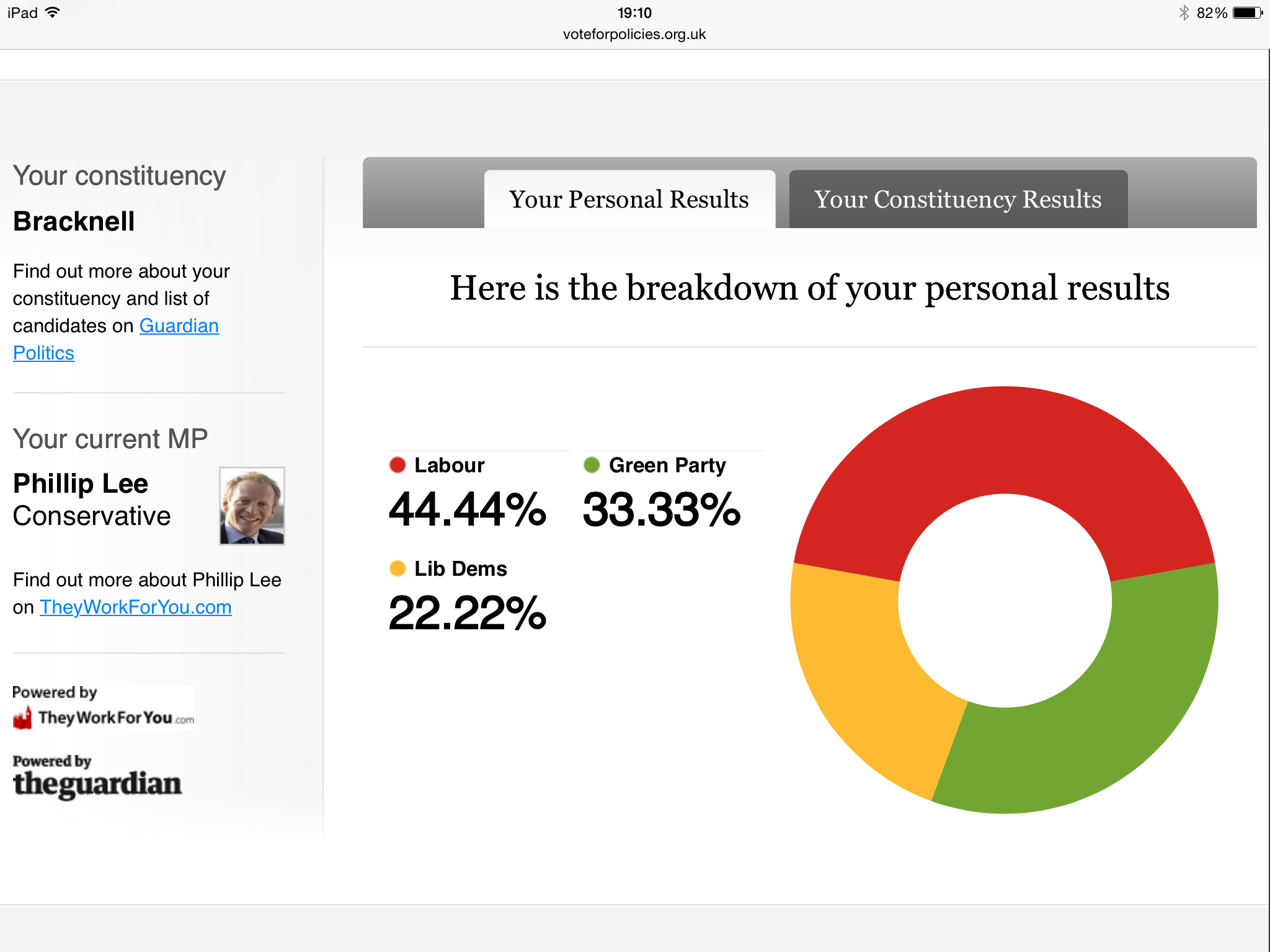 This is not too dissimilar to my constituency picture with Labour, Green and the Liberal Democrats followed by the Conservatives and UKIP.
 Which is nothing like how the constituency voted in 2010 or indeed in my living memory.

Source: Guardian
What Does this Tell Us?
It is not surprising that leftist advocates will happily point to vote for policies as a better way of deciding on your vote. The overall position consistently puts the Greens, Labour and the Liberal Democrats ahead and recently the Greens have surged. Many suggest this is indicative of the current green surge and whilst I’d like it to be so I’m not sure about using the data so uncritically. The picture for my constituency is totally at odds with what happened.
Some possible reasons for the difference and reasons to use Vote for Policies with caution include:
- voters only discovered Vote for Policies after the 2010 election and had they had tools to help them separate the policies from the personalities they may have voted differently?
- Vote for Policies is seen as interesting but mostly a bit of fun and established media and campaigns have much greater influence in voter decisions.
- The sample size is small. Vote for Policies didn’t reach that many people previously but may play a bigger role in the coming 2015 election.
- An online tool like this appeals only to a minority of voters in certain demographics. There is no demographic breakdown for the constituency or overall responses. Those advocating the tool are likely to be tech-savvy, media literate and used to obtaining their information from diverse sources. Do these really represent the core voters who turn out and decide elections?
- The algorithm for calculating scores is only simply described on the FAQ page and is quite simple. Is this kind of averaging the best way to represent choices.
- As far as I can see there is nothing to prevent people ‘gaming’ the system.
- In some cases it is blatantly obvious which party is which. The policies are compiled without editing except to remove party names. This is admirable as editing brings its own problems but different parties have quite distinctive language. Their rhetoric is still discernible in their policies even out of context. More neutral language would make it harder to distinguish part policies by their language. Given this someone could go through and simply vote for the policies they recognise from their party rather than make an “informed, biased choice”.
- There is nothing as far as I can see to stop people completing the survey multiple times to influence the results.
I also found it interesting to note that not everyone taking the survey is examining every issue. The issues that voters are selecting may tell us something about priorities with Health/NHS top with 404.2K votes followed by Education (392.1K) and the Economy (379.6K). Europe is least voted on (258.6K) so perhaps these agonised debates about the European Union have undue prominence. Bearing in mind the caveats above there are still little vignettes to chew over such as the Liberal Democrats leading on Democracy and reflecting on the possibilities for democratic reform they have squandered this parliament.
Going Forward
Whilst I want the Vote for Policies outcomes to be truly representative of how people would vote if they focused more on policies I am concerned that it’s not enough to hold up data that reflects your point of view and use it uncritically as a campaigning tool. Despite the prominence given to overall results on the site I’m also not sure this is the intended use of the tool.
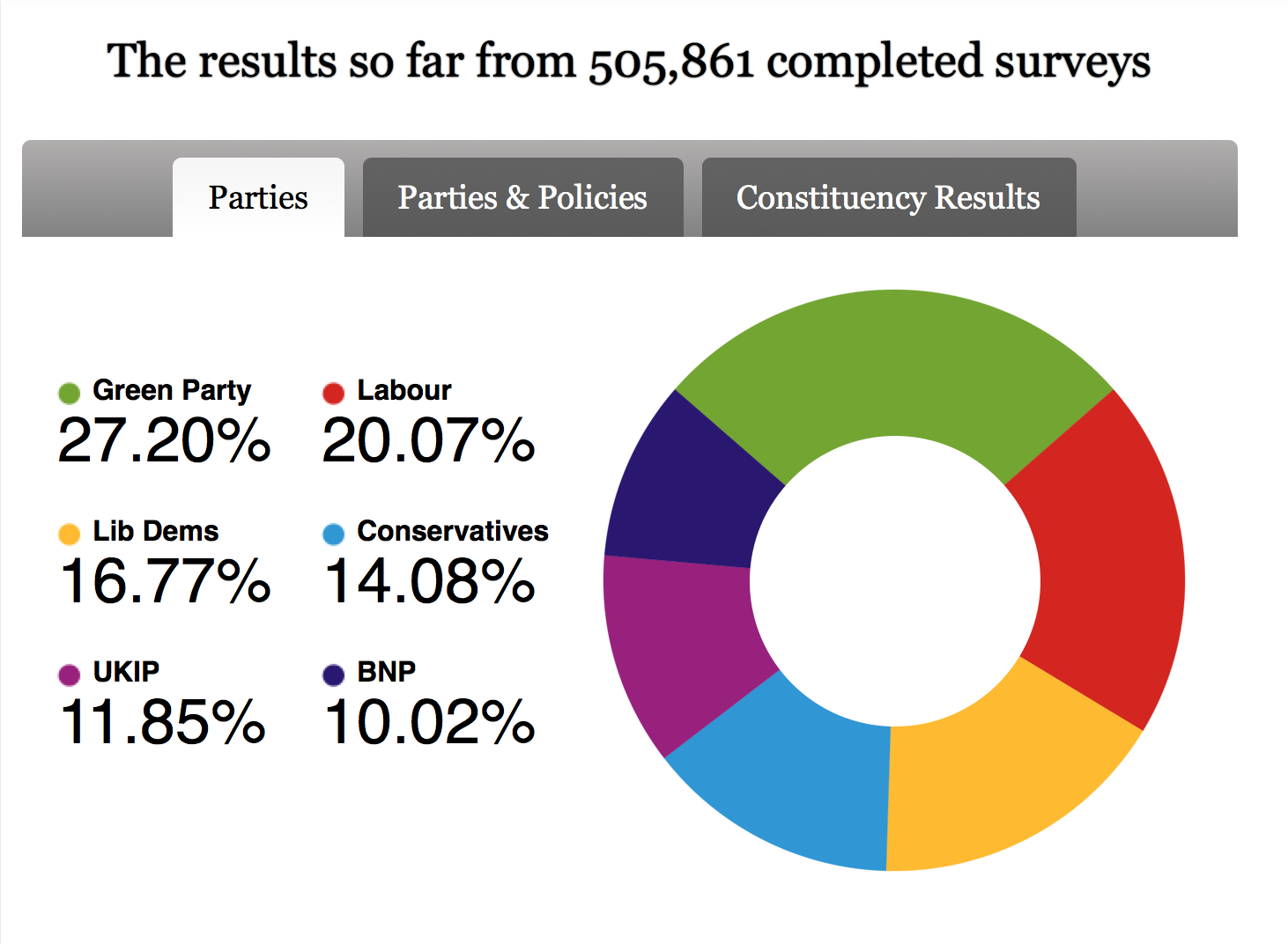
The current Vote for Policies results. It looks good for the left but how representative is it?
There are too many caveats and questions about how the data is compiled. If Vote for Policies are hoping to be more powerful this time around, or at least tolerate use of their data for campaigning, they might need to address some of these and be more transparent about their data and maybe even open it up. Certainly if multiple survey completions by the same people can’t be prevented the data isn’t that representative generally and those using it as a kind of opinion poll should do so with caution.
Where Vote for Policies works best is in the particular: as a useful tool for individuals that aids the engaged voter review, compare and contrast all policies on a particular issue in one place.
Despite my reservations I do appreciate all the work the team behind Votes for Policies are putting in to help present information differently and making it simple and clear for voters to compare parties on key issues. I am looking forward to seeing how they refresh the site and the policies over the coming weeks.
I will take the survey again once it has been revised to see how my views change and to critically appraise the update. I’ll also continue to keep an eye on the overall data and how people use both the tool and data during the campaign.
 GreenFinch Song