All That Remains

So here we are. The United Kingdom has left the European Union, the joint political and governmental institutions of Europe. Accepting the reality of this situation is not the same as liking it.

It pains me that we have rejected principles of cooperation and mutualism. It annoys me that the left defended these principles so poorly and chose a more parochial oath. It bewilders me that a right that lauds our own union of nations and that of American states and a left that lauds unions and cooperatives as beneficial organising methods should both abandon a noble attempt to scale-up unionism as an alternative to warfare. It saddens me that for the first time in my life I woke up this morning with fewer rights than I had before. It concerns me I still don’t know what exactly those rights have been sacrificed for or what will gilt this heralded national golden age.

I remain a Brexitsceptic.

I hope to be proved wrong. I hope we succeed, despite my doubts, in thriving as an independent trading nation forging peace, prosperity and friendship with all nations. I’d happily be as wrong about Brexit as those doomsters and gloomsters who thought wind turbines wouldn’t pull the skin off a rice pudding were about our ability to generate renewable energy. I want to believe in the promise of great things to come but I need more substance to the optimism.

We remain though, European.

Not just geographically, but rooted in the fundamental and enduring values of liberty, equality and solidarity. Along with 46 other countries we are members of the Council of Europe, the organisation founded by the Treaty of London in 1949 to uphold human rights, democracy and the rule of law.

Today is both much the same and yet fundamentally different in as yet unseen ways. All these facts and feelings need to be wrangled into a new way of being.

So Long Status Quo

I’m someone who wants the EU to exist, wants to be part of it but also wasn’t entirely uncritical of it. Like any complex system its both good and flawed. Like many people I wanted the EU to become leaner, more democratic and agile albeit in unspecified ways. I was supportive of that journey even if fraught and slow and bedevilled by crisis. What large-scale project isn’t?

When the choice was between leaving and continuing our bespoke membership I found it easy to be a remainer.

I thought the UK’s bespoke membership was a good deal for us. Negotiated over decades it made the best of this all-round scepticism and has bought us a large measure of peace, prosperity and productivity for limited concessions. It was home. It was worth fighting for. We may find out we did indeed never have it so good.

However, when polled in the referendum, a majority, albeit slim, disagreed and were not persuaded that the benefits of membership outweighed the constraints. We have been negotiating the consequences of that mandate ever since and probably will be for many years to come.

During the Article 50 negotiating period I continued to argue for the merits of our existing deal by probing the suggested alternatives and pressing for a specific, single option to be compared with the status quo. For me the 2016 referendum was a matter of principles and I advocated for a second one to consider the practicalities. Given there is no recorded majority for any single option (leave encompasses several alternatives to membership), the unanswered question remains: what is the people’s second preference?

In a democracy, we contest then live with our collective decisions. Now the Article 50 process has concluded those arguments are moot, mute. A new phase begins.

Still, The Europe Question

This is a transformative moment for Europe too. Losing a member state for the first time, approaching the end of the stabilising Merkel era, grappling with the macro forces of migration, climate and technology, the destabilising geopolitics of Trump’s foreign policy, the threat of trade and information warfare along with Middle Eastern conflict and faltering neoliberalism and rising populism in political ideology.

The remaining members could find that the tensions of the EU’s murky statehood are unsustainable and unreconcilable. Does the EU represent a shared Europe or a single Europe?

The institutions of the EU are feeling the strain but they also have their own opportunity for renewal and redirection. There is a new Parliament and Commission and a new set of strategic priorities. I hope the EU finds a way towards social democratic principles and sustainability under the auspices of initiatives like the European Green Deal.

Like it or not, these are no longer questions for us but they remain inherent in the European Union project.

Given our ambiguous position a stark choice between europhilia (ever closer union) and hard euroscepticism (complete exit from EU jurisdiction) perhaps had to be faced but was in fact never even on the table in the referendum debate of the last three years (as far as I’m aware remainers were campaigning for the status quo or evolutionary reform not a switch to standard EU membership).

I’m not entirely sure what I would choose if being British European meant opting form standard membership rather than continuing to muddle along as we were. We’ve always been bespoke European, not all-in. Brexit has made it clear that many people choose sovereignty even over economy. That’s why I find it hard to see a movement to rejoin any time soon as surely that way both greater pressure towards standard membership and fraught debates on the EU’s direction of travel lie. Finding a UK majority for that is I suspect a long time and/or a lot of pain away.

The campaigns of the last three years have been about getting Brexit done, not about what comes next. The referendum of 2016 set the course to this point but it neither asked what should come next nor decided on the alternative(s) to EU membership. We’ve effectively ruled out three options but haven’t definitively decided on a way forward yet though the likeliest is some form of bilateral agreement.
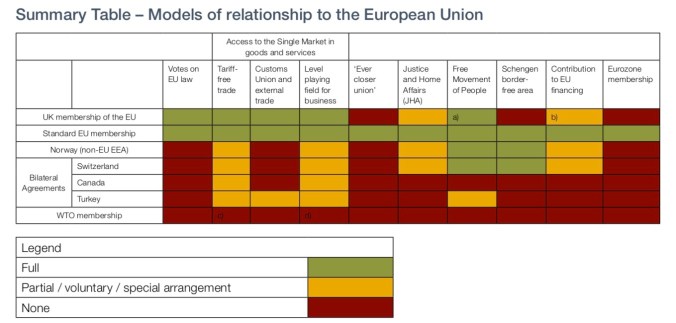
Table: Models of relationship to the European Union

This next stage, negotiating a new British and Northern Irish identity, a new way of operating and new ways of trading internationally begins now and will take years to complete and is without a definitive mandate. This is the debate we move onto and it’s one that doesn’t belong to leave or remain, but to all of us.

With the first two of these models, those concerning varieties of EU membership, now firmly ruled out, fulfilling the 2016 referendum mandate, the question remains which of the alternatives should, will, form the basis of the future relationship with Europe? We face months, maybe years, having done Brexit but still debating the ‘reverse Swiss’ or the ‘Canada plus’ or the ‘cliff edge’ of no-deal. The people now have no say; the Government will decide.

They have to figure out what a new relationship with Europe looks like, how that fits with other trading opportunities and how to fairly share the costs and benefits of this path. This will take long and painstaking diplomacy and a period of adjustment. The trade offs and tough decisions involved haven’t gone away just because the bells tolled (or not) on Brexit day.

Replacing EU, So Much To Do

I’m not going to stop stop challenging the assumptions, policies and tactics of Brexit as a strategy or the Government’s delivery, probity and integrity just because we’ve reached the implementation stage. It’s even more important to do so now. After all we have so much to do now to make this work and there’s only the sketch of a plan.

The recent triumphalism seems premature when not only do we need to replace all that our EU membership provided, the trade, the science, the security, the structural funding, but there is the pressing domestic agenda needed to repair a crumbling public realm neglected by austerity in order to provide homes, jobs, education, opportunity and care more equitably along with levelling up regionally and economically and sharing the Brexit dividend around fairly.

The New Conservatives now in Government have to move on from the slogans and nail the specifics to deliver on all its promises for this so-called golden age. We can help but they must lead and act on their words. No excuses. No evading scrutiny.

It’s tempting for those of us who think this is the wrong course of action to continue to protest, look for the worst and stand like a chorus of Cassandras as the country moves on. I think this would be a mistake. Given we cannot prophecy the future it risks chauvinism when we need stoicism. Our critique needs to be pertinent not petty. We need to participate not just protest and do our best to both guard against hubristic jingoism and make sure our own misrerabilist predictions don’t become a reality.

We need to help forge this new place in the world if we want it to be something we can celebrate. We have to push for close partnership with our European neighbours based on our common values and objectives whilst exploring new opportunities elsewhere. Find ways to continue to be bespoke Europeans, members of the Commonwealth, global operators and distinctively, proudly British.

Above all we need to focus ruthlessly and relentlessly on what really matters: that people get the homes, sustenance, work, environments, communities and care they need in ways that are respectful to all the life our planet sustains.

Seizing the Opportunity

After all neither Brexit or EU membership are ends; they are means.

Systems thinking leads to another conclusion, however, waiting, shining, obvious, as soon as we stop being blinded by the illusion of control. It says that there is plenty to do, of a different sort of “doing”. The future can’t be predicted, but it can be envisioned and brought lovingly into bring. Systems can’t be controlled, but they can be designed and redesigned. We can’t surge forward with certainty in a world of no surprises, but we can expect surprises and learn from them and even profit from them. We can’t impose our will on a system. We can listen to what the system tells us, and discover how its properties and our values can work together to bring forth something better than could ever be produced by our will alone. We can’t control systems or figure the out. But we can dance with them.[^1]

The means may have changed but the ends of liberal, ethical and social democracy remain the same: a society that is free, fair, equal and sustainable

However way you look at Brexit this is a transformative moment for our country. Such moments are disruptive but also provide the opportunity for radical renewal. We shouldn’t cede that ground. We can use this moment to regenerate, innovate and lead the way towards a new political economy that finds prosperity and peace in being socially just and ecologically sound.

These goals remain as important today as they were yesterday. So we have to roll up our sleeves, elbow our way into mapping out this new direction and change the narrative.


References

[^1] Donella Meadows, Thinking In Systems. 2008. pp. 169-170

Cover Image: Britannia by Tom Purvis
Rooted/Routed

How the spaces of place and flows are realigning politics.

After four tumultuous years the European question may finally be settled for the UK in 2020 albeit not fully resolved. Beyond the foremost question of Europe lie the threads and consequences of a political realignment we can barely discern.

We don’t yet know what will happen on election day but it’s worth thinking about what’s happening and what might come next. For me, the most interesting and determinative question in the next Parliament may be how well the Brexit coalition can hold together and to what ends? The broader question is how will politics reconfigure around the realigned outlooks and revised ambitions of the shifting groupings within remain and leave once Brexit is concluded one way or the other?

Roots and Routes

First it’s worth thinking about how the remain and leave coalitions are constituted and how traditional party affiliations have been fractured under the demands of the network society. There are many existing social classifiers that provide lenses on political affiliation such as employment, income, religion, age, ethnicity and education. I’ve been thinking about these can be augmented by borrowing and adapting Castells’ idea of spaces of place and spaces of flows and our relationship to them.

Spaces of place are more fixed, both geographically and by identification with enduring imagined communities. Spaces of flows are more kinetic and mutable; they are the financial, logistical and information networks that connect and circulate.

These concepts allow us to consider the way people are rooted in place and how they are routed by flows as further facets of social classification. People’s political alignment can be influenced by both their affinity for place and their access to flows and this might help explain some of the potential shifts in this election. I think this leads to six broad groupings in the network society that political parties are attempting to organise into a majority.

The Remain Coalition

Remainers are a coalition of two broad groups.

They are the social democrats and conservative/christian democrats: the centre left and centre right of European liberal democracy. The political power they have traded between them throughout the decades of European membership has withered leaving them adrift, bewildered and uncertain but they have found it harder to leave their traditional political boundaries and come together in common cause than leavers.

What remainers do have in common is they are mostly are routed in flows having a more globalist outlook but it’s a globalism that is rooted in a European identity. They live in cities and their metropolitan hinterlands stretching out into well connected villages but they have failed to fully realise the distinctiveness of place or the inclusiveness of flows never mind integrate them into a persuasive whole.

They like the world as it is, it works well for them, so have been motivated to do little more than preserve and extend the status quo and pursue incremental progress. They are beginning to recognise this may not be enough for local community, environmental sustainability and social justice and the space of flows may not be the unalloyed good they thought, having unintended consequences for places, but they are unsure how (radically) to respond.

The Leave Coalition

Leavers seem to be a coalition of three broad groups.

There are those that are firmly rooted in place, having been left behind or chosen to stay behind a more globalist world. These places are Britain’s towns: former industrial hubs, fading seaside resorts, the empty markets and exchanges of the shires, places no longer bustling but hollowed out and disconnected. These are the places Brexiteers and Lexiteers want to protect and revive in the comforting embrace of national pride, solidarity and industry. They want more control over the space of flows. Their lives and their loyalties are increasingly precarious and their votes are increasingly crucial to swing elections.

Their opposites are the libertarian free trading globalists who want to open up Britain even more finding flows that go far beyond Europe and reach even further into every part of our national infrastructure including those services still in public hands. Place and time collapse and blur. Their world is one where Britain (at least its major cities) thrives as a global broker of powerful flows of goods, services, knowledge and money. A world where there are few if any protections only opportunities, where corporations rival national governments, and if you rise to the top you must be the cream.

Sitting slightly in between these positions are the Atlanticist and Anglospherists. They value close connections with former dominions such as Canada, Australia, New Zealand and above all the special relationship with the USA. They are the twins of remainers in that they too take advantage of the space flows but differ in that their globalism is rooted in a commonwealth identity, tinged perhaps even with a nostalgia for English-speaking empire.

The Eco Coalition

It’s worth mentioning one other grouping that is increasingly significant but doesn’t weigh too heavily on the present remain/leave organising binary of Brexit politics.

This is the radical green movement, the protectionist but progressive globalists. They are the antithesis of the free marketers: seeking commons not capital in the space of flows. To them the world is both routed and rooted by its materiality: a space where biological, ecological, social and informational systems intersect and where place and flow intermingle.

They are idealistic, mostly young, small in size but growing. They want both connections and protections for all at planetary scale but struggle to find a route to power through traditional local, national, corporate and multilateral structures so their influence, whilst increasing, remains diffuse.

Finding a Majority

To govern the United Kingdom you need a majority. Theresa May and Jeremy Corbyn have each attempted to form a majority that negotiated leave and remain, space and flows by trying to unite remainer democrats with the nationalist precariat (in May’s case with the commonwealth and in Corbyn’s case the climate coalition) with visions for one-nation centrism and radical socialism respectively. So far this hasn’t quite worked.

Boris Johnson’s strategy is different: focus on holding the leave coalition together as long as possible by talking about the future as little as possible beyond immediate objectives to get Brexit done and invest modestly in the key areas of health, education, crime and defence that may also appeal to wavering Conservative remainers.

Despite having very different motivations, these three groups In the leave coalition have coalesced effectively around one short-term aim, leaving the European Union, and are prepared to work together to achieve it. We’ll find out soon whether this focus proves to be electorally successful (again).

If Brexit is achieved though, their unifying force dissipates and it would be interesting to see how the differences between them can be reconciled and how both the rooted and routed can be satisfied.

If not, what will win out: the space of place or of flows?

Deal or No Deal

Brexit mistakes. There have been a few.

An overly simplistic referendum that gave no say on the future relationship.

A general election that hung Parliament and muddled the mandate.

Too many arbitrary constraints and too few requirements.

All the name calling and bad faith.

The unnecessary bombast of ‘No deal is better than a bad deal’ that has polarised both sides and made us unwilling to accept transitional states.

‘Do or die’ rhetoric escalates this towards phony war rather than constructive diplomacy.

We could be coming together around the idea that a satisfactory deal is better than no deal and taking the first steps on a long, collaborative process of withdrawal, reimagining and reconfiguring.

Instead we’re flirting with schism, radical disruption, constitutional stress and emergency response planning.

The risks and rewards of such a scenario are unevenly spread. Some can afford to be more optimistic about it than most.

Where We Are

The current government position is that they would prefer to exit with an agreement but are preparing to exit without one.

Despite having an agreement and wanting an agreement the current government has yet to sit down to negotiations with any party having set new demands around the Protocol for Ireland / Northern Ireland (known as ‘the backstop’).

The extension to Article 50 agreed by the UK and the EU ends at 11pm GMT (midnight CET) on 31 October 2019.  At that point the UK would exit the EU without any agreement on a future relationship in place.

Where We Could Go

This scenario has prompted many thoughts on how exiting without a deal could be avoided.

The simplest one, to ratify the withdrawal agreement (WA) signed by the Government and the EU, is unpopular with both MPs and the wider public.  It is widely thought this option is now unfeasible, though it is not impossible.

The next option would be for the Government to renegotiate the agreement.

The EU have said they are willing to reopen the withdrawal agreement but would be receptive to amending the accompanying political declaration.

The UK government won’t enter into negotiations whilst the backstop remains in place but have given no indication of what guarantees could replace it.

Again not impossible but someothing has to give for negotations to even commence, never mind conclude.

It’s concerning the Government seems to be pursuing the last resort contingency plan to protect against no deal with much more vigour and intent than their stated preferred way forward.

I’m not convinced by the tactical displays of overt preparedness but it remains to be seen what their approach will be come September when Parliament and our negotiating partners cannot so easily be avoided. At some point the substance of their strategy will have to be revealed.

Consequently, discussions, some more open than others I’m sure, are taking place between MPs and the public in how to challenge the Government and prevent they UK existing without an agreement.

This has become an intricate constitutional debate covering legislation, convention and democratic legitimacy.

The proposed sequences of events needed divert the government, whilst not impossible, mostly seem implausible.

It remains to be seen how this debate plays out.

Deal

Personally, I think leaving without an agreement (no deal) would be a desparate failure and an unnecessary crisis that places the nation under great pressure and flirts with disaster.

I reject the right wing libertarian vision of Britannia Unchained that embraces the creative destruction of this scenario.

Those who think this would be a desirable test of our mettle are not those who would be on the frontline dealing with the consequences and fearing for their livelihoods.

Leaving without agreement is not what was promised, the risks are too great, the rewards too unclear and it’s not even the preferred outcome of the people implementing it, never mind a majority.

It’s as extreme as Remainers advocating joining the Eurozone.

By forging towards such an outcome, the Government may succeed where May failed and open the Overton window so wide to no deal that a majority acquiesce to the withdrawal agreement.

Leaving was not my preference but I’m becoming resigned to the view that exiting into an agreed transition period by the 31st October would be the option that covers most of what most people could eventually accept.

In fact, I’m one of those few people who could accept the withdrawal agreement the government has negotiated on our behalf as it stands given it governs only transitional arrangements not the final, future state. It is not perfect but it will do.

We would exit the EU and enter transition.  The 2016 referendum mandate would then be fulfilled (it was mute on the shape of a future relationship, transition and the length of withdrawal).

By October, if the Government continues to refuse to sit down and negotiate and if Parliamentary mechanisms to force alternatives to no deal fail then Labour could, as a last resort, call the Government’s bluff and offer to support the WA.

An ultimatum.

The Government might not welcome such an offer. A clear majority for an available agreement, would really test the Government’s contradictions, coalitions and arbitrary deadlines.

No deal would no longer be a passive outcome for the Johnson administration; a default easy to blame on the inaction and intransigence of others whilst they electioneer. No deal would become an active choice, one made and owned by the Government.

To many this may feel like supporting a bad deal. It may feel like a capitulation that validates the Government’s hardline tactics. Six months wasted and the huge sums sunk into no deal planning gone. All valid feelings.

I want to remain but not as an article of faith beyond reason. Not if a perverse outcome of continued resistance would be no deal or the further erosion of democratic legitimacy.

That’s because if everything else has failed, passing the WA could still avert no deal. If we say we’ll try everything we must be prepared to countenance this.

A bitter end.

Remember though that the WA, however flawed, is temporary. It is not the end, it is merely the end of the beginning. If it’s a bad deal replace it with a better one as soon as possible.

There would still be much to do and fight for. We would be prepared for a shorter transition. Still be an opportunity to partner with the EU in many ways under a future relationship.

Ultimately, no deal is not better than a bad deal, it’s the worst.

Moving On

I would then want a general election.  This is likely to be the condition of any successful cross-party pact.

The current Parliament is hung, drawn and frayed; it will have implemented the referendum result (the withdrawal).  

A new Parliament should be elected to manage the transition, find creative ways to involve us all in a connective and collaborative national conversation, and negotiate future relationships, first with our close European partners, and then internationally.

Those negotiations would be far easier within a transition period that allowed an orderly exit from those EU institutions we wish to leave and a period of adaptation. The political declaration isn’t binding so any and all future relationships remain up for negotiation and available to us post-transition.  It’s just we won’t be in crisis management mode at the same time.

A general election would be crucial.  It will be campaign, a vote, a competition between three very different political economies about the nation we wish to be.  With exit under way it would be all about the future.  Whoever seizes that moment will likely have five years to reshape the nation in their image.

That future starts now.


Epilogue: A Neverending Story

Whilst clearing out old posts on another blog I found Time for the European Debate to Grow Up.  I wrote it 15 years ago.

For context it was written approaching the 2004 European elections.

Earlier, in April 2004, the government had promised a referendum on the proposed European Constitution.

That referendum was subsequently cancelled. The European Constitution was replaced by the Lisbon Treaty that was ratified in 2008 without a referendum. The BBC have a good timeline.

I look forward to sharing my thoughts on the relationship between the UK and Europe in 2034.  Not sure how I’ll be publishing that.  Immersive storycasting, information pill or mind meld perhaps.

Our future: a question for the people

Returning to the electorate is the most democratic way to resolve the current Brexit impasse.

The 2016 referendum has not been ignored or betrayed.  The Government and Parliament have been working on Brexit for 3 years now.  A withdrawal agreement has been negotiated.  As has a political declaration on a future relationship.

Parliament continues to debate but reject these.  This has been hard work and has taken up much Parliamentary time detracting from other much needed business that mean the underlying conditions of austerity, inequality and alienation still fester.

The next democratic step forward would be to seek further instruction from the people now a deal has been concluded.

A single issue ballot

Doing this via general election or treating the European elections as a proxy referendum risk making those single issue elections when they are so much more than that.  In those elections voters should feel free to vote for the party or candidate they think would best represent them in the UK or European Parliament across all issues.

I have sympathy for those who argue this is how European elections will be interpreted though.  Polls generally suggest that pro-Brexit (Brexit party, UKIP) and pro-Remain (Greens, Liberal Democrats, Change UK, SNP) camps are equally balanced on around 25-30% of the vote.  Labour and the Conservatives poll around 40% for their orderly Brexit negotiations, leaning slightly softer towards the Labour version.  The headline splash of the neo-Faragist pale blue is a focal story though whilst you have to add up the pro-Remain parties to establish their equivalence.  In a media ecosystem big on amplification and short on attention these snapshots matter.

However, I still think a single issue question demands a single issue vote.  The question of Europe should not have been put to the people in 2016 when it wasn’t a single issue question, but it needs to be put directly to the people now it has become one.

Brexiteer outrage that consulting further withe the people on Brexit and allowing the electorate to choose a relationship with the EU is a democratic betrayal that would precipitate violent disorder is misplaced.  It is their undemocratic way of clinging to their one, ill-gotten, success and deflecting from their subsequent political failure to deliver.

With Government collective responsibility and party discipline unravelling we are left with a hung Parliament that is exhausted, bereft of ideas and running short on Parliamentary business.  They can only anchor their arguments with what the public thought then not what they think now and the end of the negotiation period.

We can also see from these polls that the Conservative vote is crumbling.  It now faces a three-way challenge from the Brexit Party and UIP on the right and Change UK on the centre.  If the 2016 referendum was designed to settle the European question and unify the Conservative Party it has been a miserable failure.  Party considerations are still coming first despite the ramifications for the nation as a whole.  This question of our future with Europe must be separated from party politics.

The choice of a future relationship must be put directly to the people

I would favour a choice between the deal we already have (our EU membership with it various rebates, opt-outs and vetoes ), the terms and direction set out in the Government’s agreement or the preferred deal of Parliament.

This latter should be the option that prevails in Parliamentary indicative votes once EU membership, the WA and procedural options such as a revoke/referendum has been excluded.  Just a straightforward indicative vote where MPs must vote for one of the options put forward.

The option with the most votes (it wouldn’t have to be a majority) would be put forward as Parliaments proposal.  No abstentions, no votes against.

Realistically it would therefore be one of Custom’s Union, Common Market 2.0, Malthouse compromise or leave without an agreement.

This would allow an option to deliver the Brexit mandate to be proposed by both the Government and Parliament as two leave options alongside our current membership arrangements.

The challenges of a free and fair referendum

This would be a difficult referendum.  The question would matter.  The conduct of the referendum would matter.  The campaigns would matter.

We would need to move on from current terminology which is mostly about principles and procedures and focus minds on the terms of specific future relationships with Europe, a trading partner we cannot ignore.

Unfortunately , the lessons and irregularity of the precious referendum have not yet been heeded.  Our systems will struggle to redesign democracy for the social media era.  This challenge cannot he avoided though; it must be confronted and we must try.

Damian Collins’ select committee investigations lead the way in tackling these challenges but resolving them would take longer than needed to answer the question of Europe in the current time frame.  Our democracy must be reformed for  21st century by the next general election but for now temporary arrangements would be needed to allow people to deliberate and vote freely but fairly, avoiding the hazards of the previous campaign whilst allowing a referendum to be held this summer.

A national conversation

This is where a citizen’s assembly or other temporary representative mechanism could come in, to deliberate on this question alone outside party structures.  This assembly could contain advocates of each option to debate and discuss.  These three assembly groups could be charged with leading each official campaign supported by the civil service and each working with a publicly allocated budget and an independent fact checker.

Ideally, there would be devolved regional and local assemblies beneath a national assembly engaged in their own town hall and market place open spaces that feed into the national conversation like tributaries.

This is a question of national importance; it should be transparently funded by taxpayers not hidden donors. We do not need the same tired party politics and media conglomerations.  Nor do we need dark ads and propagandist bots.

We need new voices, debating the future, not the past.  This referendum should be a decision made by all, for all, based on a national conversation that informs and includes all.  At the end of this national conversation we have a ballot that hands a renewed mandate to the Government and Parliament to work on over the next 3 years.  The people can then start on the next national conversation we need: on the need to urgently respond to our changing climate.

This won’t be easy, and we may not have much time but I have faith that where there is a will there’s a way and I am hopeful that that ingenuity, pragmatism, fair play and good humour of our nation will ultimately prevail.

Thoughts On … the Ins and Outs of Brexit Options

Brexit’s core problem is there are too many alternatives each favoured by a minority but there isn’t one option convincing enough for a majority. The leave vote was a majority against something not a homogeneous vote for something. We’re left with no obvious way forward.

Ironically, with 48% in favour, support for the EU membership we already have is probably the option closest to having a majority.

Other options for a future relationship I’ve seen mooted are EEA/EFTA, Norway+, Canada+, Common Market 2.0, Labour’s customs union based plan, bespoke FTA, plus many other variations I’ve probably missed all/any of which could’ve been meant by ‘leave the EU’.

These all have varying levels of support but there’s little evidence so far one of them could command more than 48% either in Parliament or amongst the public. Perhaps because none of them are better than what we’ve already spent 40 years negotiating. For any non-EU option we will need to step back to go forward.

And we’re still creating more options trying out different variations. They are good ideas, that should have been debated, but at this stage, with just 12 days to go, they add confusion when we need focus. The options analysis we are doing now was needed 2015-2017.

Had we broken down the various leave options and had a preferential vote on “a future relationship with the EU” rather than an in/out referendum, or indicative votes since, it would have been clear what the option(s) that commanded most support was and we probably wouldn’t be having this crisis of legitimacy.

We got the Brexit referendum so wrong. You can respect the result that was returned in 2016 and understand many of the reasons it went the way it did and still think it’s flawed as a solution: the right answer to a simplistically wrong question.

There’s also two options for leaving. With a negotiated withdrawal agreement that would govern transitional arrangements and provide some continuity/protection whilst a future relationship is negotiated. Or without a withdrawal agreement (no-deal) leaving us operating under WTO rules until something else is agreed.

So far we’ve ruled out both of these options, as well as remaining, so it’s not entirely clear how we actually leave. Or stay. Or limbo.

The preferred way forward for Parliament is now extension. Given the EU have said the WA is the only one on offer and we must leave before we negotiate a future relationship it’s not clear what an extension would achieve beyond delaying. Unless I’ve got this wrong or we are hoping they shift on these.

As someone in favour of letting the people have a better/final say I’m not actually sure what form of referendum could help right now.

A referendum that asked us to choose between leaving this way (May’s deal), leaving that way (without a WA) or remaining would potentially be seen as an attempt to split the leave vote yet still wouldn’t resolve the question of a future relationship.

This is frustrating for everyone. For all of us waiting for an outcome but powerless, for MPs embroiled in party politics and most of all for the EU. Britain keeps saying we don’t want our current bespoke membership but it’s not obvious what we are asking for instead or what would command more support than what we already have.

Meanwhile days, debates, and votes tick past and deadlines approach. We wouldn’t start from here, we didn’t need to be here, but here we are and it’s not obvious how we get out.