Letter to My MP

I am increasingly concerned by the poor example this Government sets in its conduct, it’s lack of respect for the standards in public life and its use of numerous internal investigations to avoid independent scrutiny from public inquiries, the media, the courts and above all Parliament.

The Government seems to think the PM gave a fulsome apology yesterday. He did not. Nor have the many questions been answered. They were not answered in either PMQs or the UQ, they were not answered in the lobby briefing.

An internal investigation into the many reports of gatherings in Government contrary to the guidance the Government issued to the public is necessary but insufficient.

Ministers need to answer questions put to them by MPs in Parliament.

Their testimony should be fully transparent.

Civil servants may investigate the civil service for the purposes of internal disciplinary proceedings but they are not in a position to investigate ministers or make a judgement on the legality of their conduct.

A Government that prizes the sovereignty of Parliament above unelected bureaucrats should recognise that.

The high court ruling this week that the use of VIP procurement lines during covid was unlawful (and it seems also unnecessary) provides another recent example of why the calls for an independent public inquiry into the pandemic response should not just be heeded but be expedited. 

That investigators are not getting the evidence they need due to (mis-)use of private devices for Government business also needs investigating. There should also be an inquiry, including digital forensics, into the Government’s poor record keeping practices. The opaqueness of the evidentiary basis for these internal reports undermines their veracity and rigour.

I have no confidence in these internal investigations. I have no confidence that the Government has any intention of abiding by the ministerial code of upholding the standards of public life.

Our democracy depends on the checks and balances evolved over centuries across the Executive, Legislature and Judiciary. I fear this Government is fatally undermining these. 

Apparently, the only comment on the Government’s conduct that matters is the ballot box. I shall use my vote accordingly.

Reorganising Government

With a new majority Government there is not just talk of a reshuffle but potentially a more radical reshaping of Whitehall, possibly in February once the EU withdrawal legislation has been passed.

Whilst we wait to see how the new administration will rewire government, I thought about how I would arrange cabinet and the structures of government to make the well being of people and communities and environmental stewardship more prominent.

Any of us can blog and generate ideas but hopefully any actual reform of government and Whitehall will be led by a responsible Minister, not an unelected or unaccountable bureaucrat, and co-designed with all relevant stakeholders, especially those most affected by it.

Government Business (5)

Firstly, there are the cabinet posts providing the central management and coordination of Government.

  • Number Ten

Provides strategy and leadership across Government. Sets a framework for lean and enterprising government that combines innovation with tradition and continuous improvement with respect for people.

  • Cabinet Office

Oversees government operations, the civil service and the values of public service. The Cabinet Secretary deputises for the prime minister. Our civil service is excellent and this department would ensure it continues to grow, adapt, recruit and advise informed by our best traditions, the principles of public life and future needs.

  • Leader of the House of Commons
  • Leader of the House of Lords

Manage Parliamentary business across both houses.

  • Attorney General’s Office

Provides the government with legal advice.

Offices of State (16)

For me there are four big themes of state: wellbeing, economy, environment and diplomacy. I’d have a Secretary of State for each of these areas as well as for individual departments to improve coordination and joined up thinking at a more strategic level. Each Portfolio Secretary would focus on coordinating three departments as well as cross-portfolio alignment.

Wellbeing

This portfolio would be charged with coordinating policies for happier and healthier people and community based initiatives.

  • Communities and People
  • Health and Social Care
  • Culture, Media and Sport

Health and social care, and culture media and sport I would keep much as they are though with a genuine effort to integrate health and social care for lifelong, community based wellbeing backed by world class specialist expertise. The biggest structural change in this area would be a new department that combined welfare, work and pensions (the current DWP) with responsibility for rights and equalities (a much tossed about floating ministry at the moment), communities and local government and takes over drugs and alcohol policy, immigration policy and vulnerable people from the current Home Office.

Economy

The Chancellor of the Exchequer would lead this portfolio coordinating efforts to improve our prosperity and productivity via a strong, balanced and resourceful economy and secure but flexible employment.

  • Treasury
  • Industry, Enterprise and Trade
  • Knowledge and Skills

The Chief Secretary to the Treasury would have responsibility for the Treasury and fiscal and financial management. Business, industrial policy and international trade would be combined into a single department and there would be a single department for lifelong learning, vocational training, research, innovation and knowledge management.

Environment

This portfolio would be responsible for sustainability ensuring that we, and the diverse life we share our part of the planet with, have healthy, safe places to live and are connected by integrated systems.

  • Habitats and Land
  • Energy and Networks
  • Security and Justice

Habitats and land would look after housing, agriculture, rural affairs and environmental stewardship whilst energy and networks would run our logistical networks from energy, to transport to digital infrastructure. The parts of the Home Office not in communities and people would merge with the Justice ministry to concentrate on our safety and security.

  • Diplomacy
  • This portfolio looks after our global presence and international relations.

    • Foreign and Commonwealth Office
    • International Development
    • Defence

    These departments remain as they are but the overall portfolio ensures the difference facets of our geopolitical functions are better coordinated.

    Offices for the Nations (5)

    Finally, there are the departments for each of this constituent nations.

    • England
    • Scotland
    • Wales
    • Northern Ireland

    This should include England. Even though England doesn’t have its own assembly I see no reason why it shouldn’t have its own office of state to represent English matters in government and coordinate with the growing number of metropolitan and civic mayors.

    Government Hierarchy

    This structure adds in a layer of government hierarchy, the idea of a portfolio of departments, to try and improve joined up thinking across departments. It’s a bit radical because in effect it downgrades the traditional great offices of state and replaces them with the four great portfolios of state.

    The levels of seniority in this government organisation would therefore be:

    1. Prime Minister
    2. Cabinet Secretary (de facto deputy)
    3. Secretary of State (Portfolio)
    4. Secretary of State (Department)
    5. Minister of State
    6. Under-Secretary of State

    Turning the Kaleidoscope

    2020 will be an interesting year, maybe even a pivotal one.

    Things have tilted but understanding how all the fragments will rearrange themselves has only just begun; it will take at least a year for the contours of our new political reality to reform.

    The status quo is in flux. There is no remaining where we are, no going back and all attention is now on a future as yet only imagined, willed and feared in equal measure.

    Change is a disorienting force that disrupts the present, chewing up the comfort of the familiar and churning out strong emotions that favour prejudice over critical thinking. We are quick to presume and preempt, to judge things based on expectation or preference rather then events or evidence. To suspect is not to know.

    I don’t know how Boris Johnson will govern as a Prime Minister with a comfortable majority.

    I don’t know when the scourge of austerity will be over.

    I don’t know how we will trade with other nations in future or the economic impact.

    I don’t know the implications of a resurgent right.

    I don’t know how liberalism or the left will regather and renew.

    I don’t know how we will arrest and adapt to accelerating environmental stress and ecological degradation.

    I don’t know how we will recognise and respond to increasingly sophisticated information disorder.

    The shape of these will become more discernible as the year unfolds. They will not be the unmitigated triumphs or disasters we immediately augur in the breaking up of things. The world usually turns out more complicated and nuanced than that. They will though be what we allow to come to pass.

    As these things fall into place we can wish for the best whilst fearing the worst. We can choose amity over enmity. We can hold all that we have in common closely and our disagreements more loosely. We can endeavour to pay attention and reject chauvinism. We can question but keep an open mind. We can campaign without becoming too comfortable with certainty or prophecy. We can hold to account without raising false alarm. We can celebrate success and censure failure. We can make the political less personal. We can pause to ask whether claims are substantiated before considering a response or succumbing to the emotions they arouse. We can strategise without scorn and scrutinise without being scathing. We can seek out facts buried under dissembling and distracting misconceptions. We can favour specific, justified critique over sweeping generalisation. We can be purposeful but mindful of hubris. We can back our words with practical action.

    Otherwise, instead of linking the chain of events to alternative arguments going forward, we will simply be buffeted by the storm of progress like Walter Benjamin’s Angelus Novus, seeing only wreckage rising skywards as we are irresistibly propelled into a future to which our back is turned.

    It is ultimately less exhausting and more enjoyable to amplify the world we want to see than to perpetually lament the ones we don’t. So keep looking for beauty and opportunity in the tumble of events. We should be sceptical and diligent but also hopeful as these new patterns shift and settle.

    Image by H. Pellika CC-BY-SA source: Wikimedia Commons

    On the struggle ahead

    It’s fair to say I’ve spent much of this week dismayed.  I feel saddened that it is principles rather than blatant wrong doing that are now seen as the barrier to success.  That what matters ever more fiercely is who you know not what you know.   That we seem to have become a nation more fervently intent on abandoning a confederation of neighbours our representatives have helped shape in the hope of favour from a more remote federal union where our emissaries are unelected and we cannot hold power to account.

    It’s a very feudal form of democracy.

    There’s a debilitating impasse at the centre of our politics and the hard right have grasped their opportunity to smash through it with their new mythology of Global Britain.  The far right succeed when they are allowed to by a weakening of representative democracy. Such politics only becomes seductive to beyond a tiny minority when people despair of all the other options.  It is a politics of last resort.  The far right’s ability to get a grip on power can then become terrifyingly absolute.  We cannot let that happen.  We cannot languish in the politics of despair and protest.

    Despite my opposition to their politics I cannot help but acknowledge their ability to persuade.  They are successful because they have a better story, even if it’s a fairytale.  They are successful because they have persuading enough people that this is their story too.

    There are things to learn from this.

    The Power of Hope

    We can criticise this axis of cronyism all we like, but it won’t change anything unless the many factions to the left of this hard right government tell a better story about their vision for Britain.

    The stream of outrage, the cataloguing of wrong dong and the calls to resist are all cathartic but aren’t creative or compelling enough to persuade.  The terrain for the upcoming struggle is the pathos of hope.

    Logos, ethos and the pathos of fear have all proved ineffective. We shouldn’t abandon these but the left needs to find a louder narrative of possibility again.

    To compete we need to be as good at communication as the populist right are.  Only without the corruption.  We can build a network as powerful through community and cooperation, through scale rather than wealth or privilege.  We need not (just) the politics of resistance or a list of popular policies but our own mythology of hope.

    We need a story that helps people to imagine there are better choices.  A story that inspires joy and confidence.  A story of opportunities to build something together, to be something together.  A story that draws people in and they want to tell to their family, friends and neighbours.

    The Disappointments of Labour

    Labour had the pathos of hope, in 2017, but have somewhat carelessly lost it.  I think their Leaver base would have forgiven Labour continuing to advocate for Remain (their referendum position) if they had continued to tell the great story they were weaving about their alternative to the status quo.  It is not undemocratic for an opposition to continue to oppose and to make different arguments about the direction of the future.

    I still think Labour made a tactical error here, alienating too many of their pro-European base whilst muffling their narrative of hope and diminishing their policy platform that appealed to all their supporters.  Their message now only reaches their hard core and their support has retreated as their vision has shrunk in potency.  More to the point the hostility of their delivery is alienating.

    Labour continue to acquiesce to a flawed referendum rather than advocate for continued scrutiny of that decision.  Yet Labour also continue to call for a general election despite coming second in 2017.  We may have a hung Parliament and a minority administration but Labour’s gains do not hide the fact they are not the largest party and seem unwilling to work with others to form a viable alternative government in this Parliament.  Nor do they seem inclined to even use all the talents across their party.  Why must the will of the people in a referendum be respected but not their will in a general election?  The repeated refrain calling for an election without changing the narrative sounds increasingly forlorn.  Their moment may still come and their approach revealed as political genius but it too often leaves me thinking if not now then when?  It fess like Labour are simply reacting to rather than shaping the political moment.

    Labour could have, could even still, choose a different path.  They could have forged a socialist alliance across Europe as part of PES whilst the EU provided enough of an establishment veneer to allay fears of revolutionary socialism in one country amongst the more moderate centre left.  It feels like the European Parliament elections, that symbolic failure of Brexit was the moment to pivot and embrace the possibilities of European socialism.  I’m sure many of us might have returned to the mood of 2017 and swung behind a European left energised by Frans Timmermans and Jeremy Corbyn.  Instead their hesitance and reluctance to consider any alternative to the strategy they have become wedded to created space for the Liberals and Greens to surge.

    How do Labour inspire now?  We all know that Labour have appealing policies that could command support.  It’s the package that’s lacking.  Mired in constructive ambiguity and accusations of anti-semitism and communicating in an increasingly petulant and tetchy way.  This is politics with a scowl not a smile.  It’s no wonder many will overlook the failings of Boris to grab at the optimism peddled by Prime Minister Johnson and his Vote Leave machine.  The left equivalent has soured and needs a refresh.

    The Mediocre Vision of the Centre

    Many centrists are coalescing around the Liberal Democrats rather than the many attempts at launching a new party for the middle ground.  Their message of Stop Brexit is at least clear and succinct enough to resonate but it begs the question, what then?

    So far their vision is incredibly conservative, more so than the newly radicalised Conservatives.  If there is a party of the status quo it is now the Liberal Democrats and they expect to attract moderates from both the centre left and centre right as a result but it is hard to see them attracting any leavers or socialists from the populists wings.  The restoration of the status quo is not going to attract that constituency who decisively rejected it.

    The politics of neo-liberal globalism are tired and demonstrably unfair.  If the liberal centre is to Stop Brexit they need to explain what lies on the other side.  It can’t be to Remain.  It has to be renew, but so far there are few signs of what that renewal might look like.

    There are so many questions we’ve failed to answer with panache.  What does it mean to be an EU member, now and in the future? Why is it best for Britain? How would things change?   How do people get their voices heard?  How do people get to make decisions about their own communities when power feels so remote? How do we be British, European and globalist?

    The answers to these questions don’t come easily to me  despite looking closely for them, because I’ve heard too few conversations that really deliberate them in a representative way.  Surrounded by more radical and transformational alternatives, the moderate challenge is to find inspiration from within a system no majority no longer support.  It’s a rearguard action that lacks a future direction.

    The Potential of the Green New Deal

    The best possibility I can see  for a new mythology on the left that can compete with the Global Britain of the right is the emerging narrative around a Green New Deal.  Which is probably why its proponents are facing such fierce attacks from right wing populists.

    This idea takes on two of the biggest challenges we face, a rapidly deteriorating environment and automating economy, and attempts to solve them through a transformative political economy of sustainability and social justice.  It’s a story about healthier and happier people connected and enriched by stewardship of their shared planet.

    It’s the kind of bold, radical and co-operative vision the centre left needs, but it remains too technocratic at the moment to have broad, emotional ‘gut’ appeal.  However, momentum is gathering and with growing cross-party support it could urgently be developed into an alternative vision of a fair, creative, inclusive and connected country, infused with imagination, optimism, kindness and compassion that tells an inviting, joyful story about the green and pleasant commons of Britannia United.

    We should not stop holding the government to account or pointing out the flaws of the populist right but we do need to spend less of our energy on demeaning arguments and tetchy tribalism and devote more of our efforts to the common ground of designing, negotiating and communicating an alternative vision that amplifies the world we want to see.  The story of us.

    Our future: a question for the people

    Returning to the electorate is the most democratic way to resolve the current Brexit impasse.

    The 2016 referendum has not been ignored or betrayed.  The Government and Parliament have been working on Brexit for 3 years now.  A withdrawal agreement has been negotiated.  As has a political declaration on a future relationship.

    Parliament continues to debate but reject these.  This has been hard work and has taken up much Parliamentary time detracting from other much needed business that mean the underlying conditions of austerity, inequality and alienation still fester.

    The next democratic step forward would be to seek further instruction from the people now a deal has been concluded.

    A single issue ballot

    Doing this via general election or treating the European elections as a proxy referendum risk making those single issue elections when they are so much more than that.  In those elections voters should feel free to vote for the party or candidate they think would best represent them in the UK or European Parliament across all issues.

    I have sympathy for those who argue this is how European elections will be interpreted though.  Polls generally suggest that pro-Brexit (Brexit party, UKIP) and pro-Remain (Greens, Liberal Democrats, Change UK, SNP) camps are equally balanced on around 25-30% of the vote.  Labour and the Conservatives poll around 40% for their orderly Brexit negotiations, leaning slightly softer towards the Labour version.  The headline splash of the neo-Faragist pale blue is a focal story though whilst you have to add up the pro-Remain parties to establish their equivalence.  In a media ecosystem big on amplification and short on attention these snapshots matter.

    However, I still think a single issue question demands a single issue vote.  The question of Europe should not have been put to the people in 2016 when it wasn’t a single issue question, but it needs to be put directly to the people now it has become one.

    Brexiteer outrage that consulting further withe the people on Brexit and allowing the electorate to choose a relationship with the EU is a democratic betrayal that would precipitate violent disorder is misplaced.  It is their undemocratic way of clinging to their one, ill-gotten, success and deflecting from their subsequent political failure to deliver.

    With Government collective responsibility and party discipline unravelling we are left with a hung Parliament that is exhausted, bereft of ideas and running short on Parliamentary business.  They can only anchor their arguments with what the public thought then not what they think now and the end of the negotiation period.

    We can also see from these polls that the Conservative vote is crumbling.  It now faces a three-way challenge from the Brexit Party and UIP on the right and Change UK on the centre.  If the 2016 referendum was designed to settle the European question and unify the Conservative Party it has been a miserable failure.  Party considerations are still coming first despite the ramifications for the nation as a whole.  This question of our future with Europe must be separated from party politics.

    The choice of a future relationship must be put directly to the people

    I would favour a choice between the deal we already have (our EU membership with it various rebates, opt-outs and vetoes ), the terms and direction set out in the Government’s agreement or the preferred deal of Parliament.

    This latter should be the option that prevails in Parliamentary indicative votes once EU membership, the WA and procedural options such as a revoke/referendum has been excluded.  Just a straightforward indicative vote where MPs must vote for one of the options put forward.

    The option with the most votes (it wouldn’t have to be a majority) would be put forward as Parliaments proposal.  No abstentions, no votes against.

    Realistically it would therefore be one of Custom’s Union, Common Market 2.0, Malthouse compromise or leave without an agreement.

    This would allow an option to deliver the Brexit mandate to be proposed by both the Government and Parliament as two leave options alongside our current membership arrangements.

    The challenges of a free and fair referendum

    This would be a difficult referendum.  The question would matter.  The conduct of the referendum would matter.  The campaigns would matter.

    We would need to move on from current terminology which is mostly about principles and procedures and focus minds on the terms of specific future relationships with Europe, a trading partner we cannot ignore.

    Unfortunately , the lessons and irregularity of the precious referendum have not yet been heeded.  Our systems will struggle to redesign democracy for the social media era.  This challenge cannot he avoided though; it must be confronted and we must try.

    Damian Collins’ select committee investigations lead the way in tackling these challenges but resolving them would take longer than needed to answer the question of Europe in the current time frame.  Our democracy must be reformed for  21st century by the next general election but for now temporary arrangements would be needed to allow people to deliberate and vote freely but fairly, avoiding the hazards of the previous campaign whilst allowing a referendum to be held this summer.

    A national conversation

    This is where a citizen’s assembly or other temporary representative mechanism could come in, to deliberate on this question alone outside party structures.  This assembly could contain advocates of each option to debate and discuss.  These three assembly groups could be charged with leading each official campaign supported by the civil service and each working with a publicly allocated budget and an independent fact checker.

    Ideally, there would be devolved regional and local assemblies beneath a national assembly engaged in their own town hall and market place open spaces that feed into the national conversation like tributaries.

    This is a question of national importance; it should be transparently funded by taxpayers not hidden donors. We do not need the same tired party politics and media conglomerations.  Nor do we need dark ads and propagandist bots.

    We need new voices, debating the future, not the past.  This referendum should be a decision made by all, for all, based on a national conversation that informs and includes all.  At the end of this national conversation we have a ballot that hands a renewed mandate to the Government and Parliament to work on over the next 3 years.  The people can then start on the next national conversation we need: on the need to urgently respond to our changing climate.

    This won’t be easy, and we may not have much time but I have faith that where there is a will there’s a way and I am hopeful that that ingenuity, pragmatism, fair play and good humour of our nation will ultimately prevail.

    Wanted: A Political Vision

    An entrepreneurial state that safeguards:

    • Security;
    • Sustainability;
    • Prosperity.

    An agile government that balances:

    • Environment;
    • Society;
    • Economy.

    An ideology that includes communism, socialism and capitalism in their rightful (effective) places to provide people with access to:

    • productive work in profitable businesses;
    • prosperous lives in loving families;
    • resilient communities in healthy environments.

    A belief system that is anchored in the 1948 settlement and advocates a shared humanity:

    • protecting common rights;
    • providing common minimum standards of welfare;
    • promoting common responsibility.

    A political party that is:

    • collectivist;
    • open minded;
    • future oriented;
    • internationalist.

    A Britain to be proud of where every citizen counts.

    Vote for Policies 2015

    The updated version of Vote for Policies was released last week in preparation for the 2015 General Election. Having tried the previous version only recently I decided to take the new version for a spin. As before the site aims to extract party policies from the personalities and rhetoric of the surrounding campaign and lay them out next to each other so voters can really focus on the issues that matter to them. They claim it helps make “an informed, unbiased decision about who to vote for” for those who might want to vote with their head as much as their heart. It still works by taking you through a survey that presents policies for different issues and inciting you to select your preferred set of policies. At the end the survey presents results of which parties you prefer based on your policy selections.

    Taking the Survey

    The new site looks great visually. It’s clear and easy to see how to get started. There are ten issues in all of which you need to select at least four to start. Being a geek I selected all ten. The next screen asks you to select your country. This is so the policies can be tailored for your region so the five most relevant parties are used. This means voters in different parts of the country will have slightly different options. This is something the TV debates could perhaps consider? For England the parties are: Conservatives, Green Party, Labour, Liberal Democrats and UKIP.

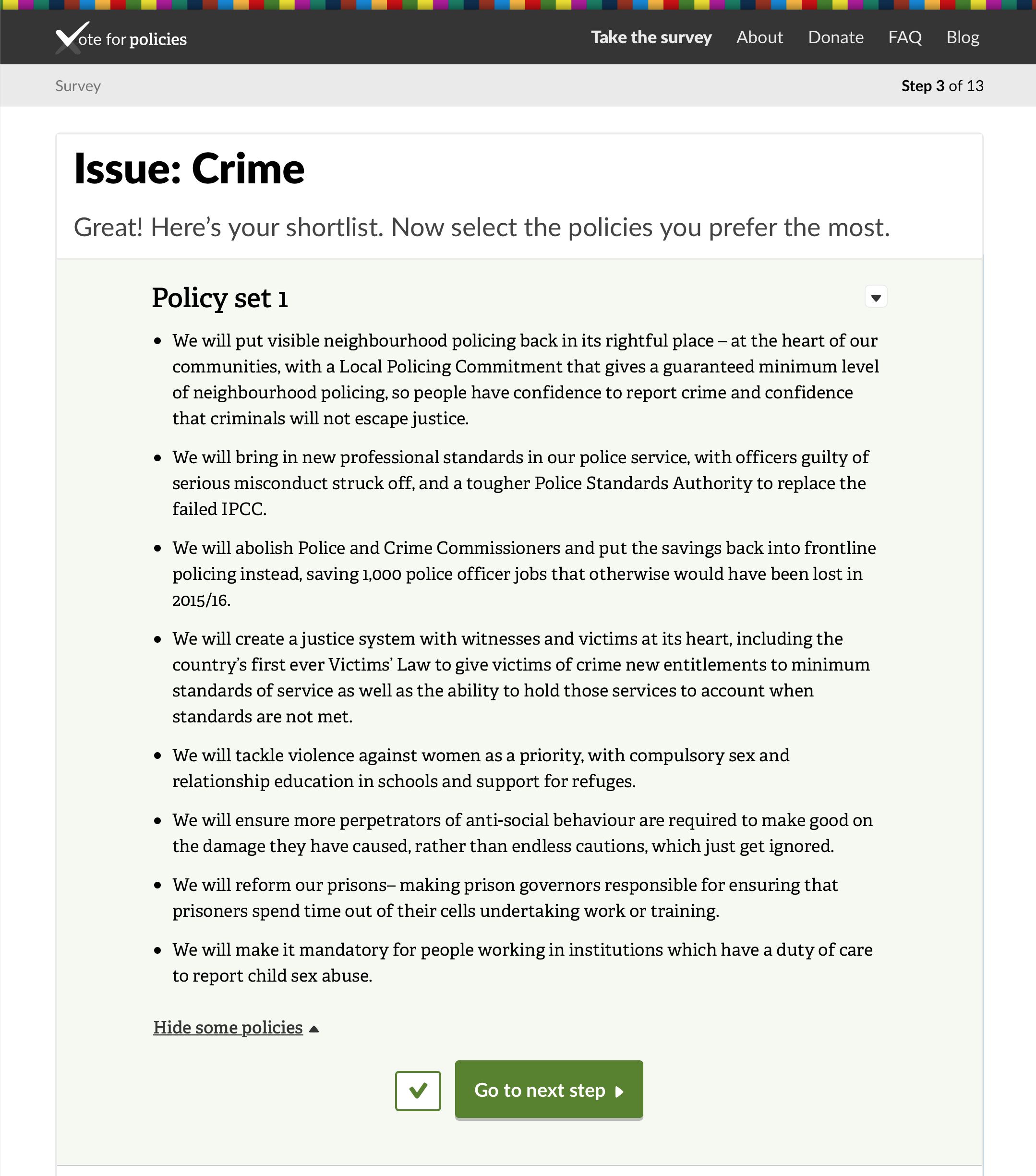
    The bulk of the survey is being presented with the policies issues by issues. Up comes the first issue and then 5 policy sets will be presented. An improvement on the previous version is you first shortlist the policies which makes comparison easier. So you review a policy set then are asked to say whether you would consider voting for these policies are not. This quickly helps eliminate policies you are not interested in.

    Once you have decided on each of the five policy sets then all the policy sets on the shortlist of those you may consider voting for are presented on a single screen. You can then pay more attention to the policy details and compare them against each other before selecting which policy set you prefer. Having done this the survey moves onto the next issue and repeats for as many issues as you have selected.

    This all takes a while, and I’m not sure if you can stop in the middle and come back, but progress through the survey is well signposted.

    Reflecting on the Survey Process

    I felt this worked well and helped reduce the amount of information at the comparison stage. For me this usually meant quickly eliminating the more right wing policies leaving me with a set of more left learning policies to compare. This isn’t surprising although there were a few areas where I selected four policy sets and one where I shortlisted all five. Some issues are closer to the centre than others it seems. I found it easy to quickly eliminate one or two policy sets from my decision. I found it much harder to select between my shortlisted options. I felt there were many good ideas and policies put forward.

    I still felt at times it was still too easy to identify a particular party. As before it is admirable that VfP fillets the policies from the party literature and leaves it untouched but some rhetorical styles and phrases are so distinctive the party appears through the policies limiting the unbiased nature of the exercise. Neutralising the language would make the policies more unbiased. Whilst their is editorial risk in doing so I did feel that it would be possible to ‘clean up’ some of the rhetorical flourishes to make the policy statements more stark whilst avoiding accusations of impartiality.

    Smart Policies?

    The other thing a focus on policy statements demonstrates is how some are more policy like than others. There is variation between SMART (Specific, Measurable, Agreed, Realistic, Timed) policy statements and vague slogans for some issues that made comparison difficult. Overall, I always erred on the side of the party who offered SMARTer policies rather than vague and slippery aspirations. This is an area where I think Green policy can improve I think and where Labour policy is very good. Still, many people would agree that the Labour Party’s problem is one of style and communication rather than substance; they would easily win an election if more attention was paid to the good work they have done in government and the good work they pledge to do beneath all the canards and red herrings town their way and the shouty froth of political mediation.

    Getting the Results

    The final stage is to enter your postcode, for constituency comparisons and then the results are presented. This was the first time I’d seen any pie charts and I think it works well that you have to take the survey before getting and idea of how your constituency and national results look as this helps reduce bias.

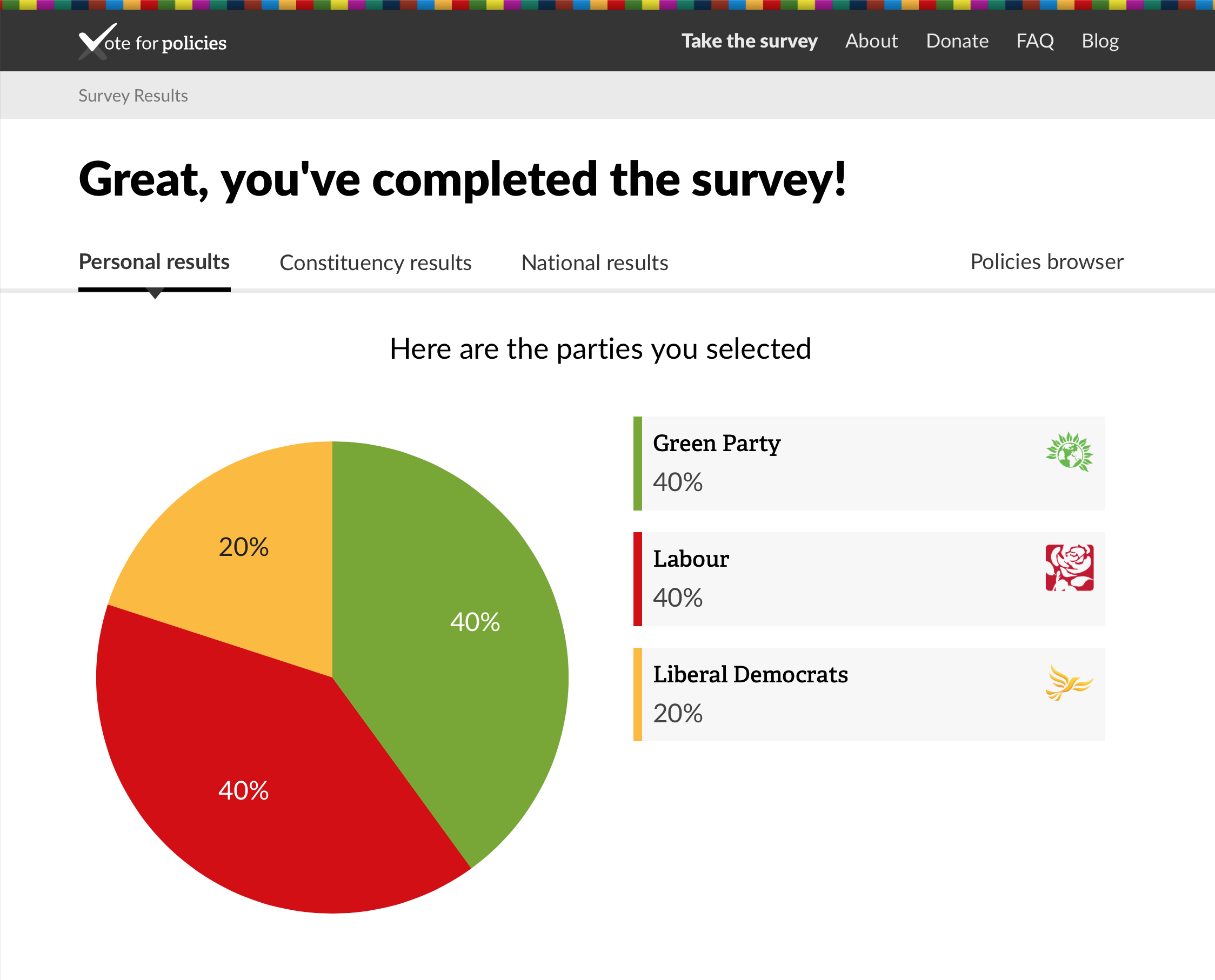
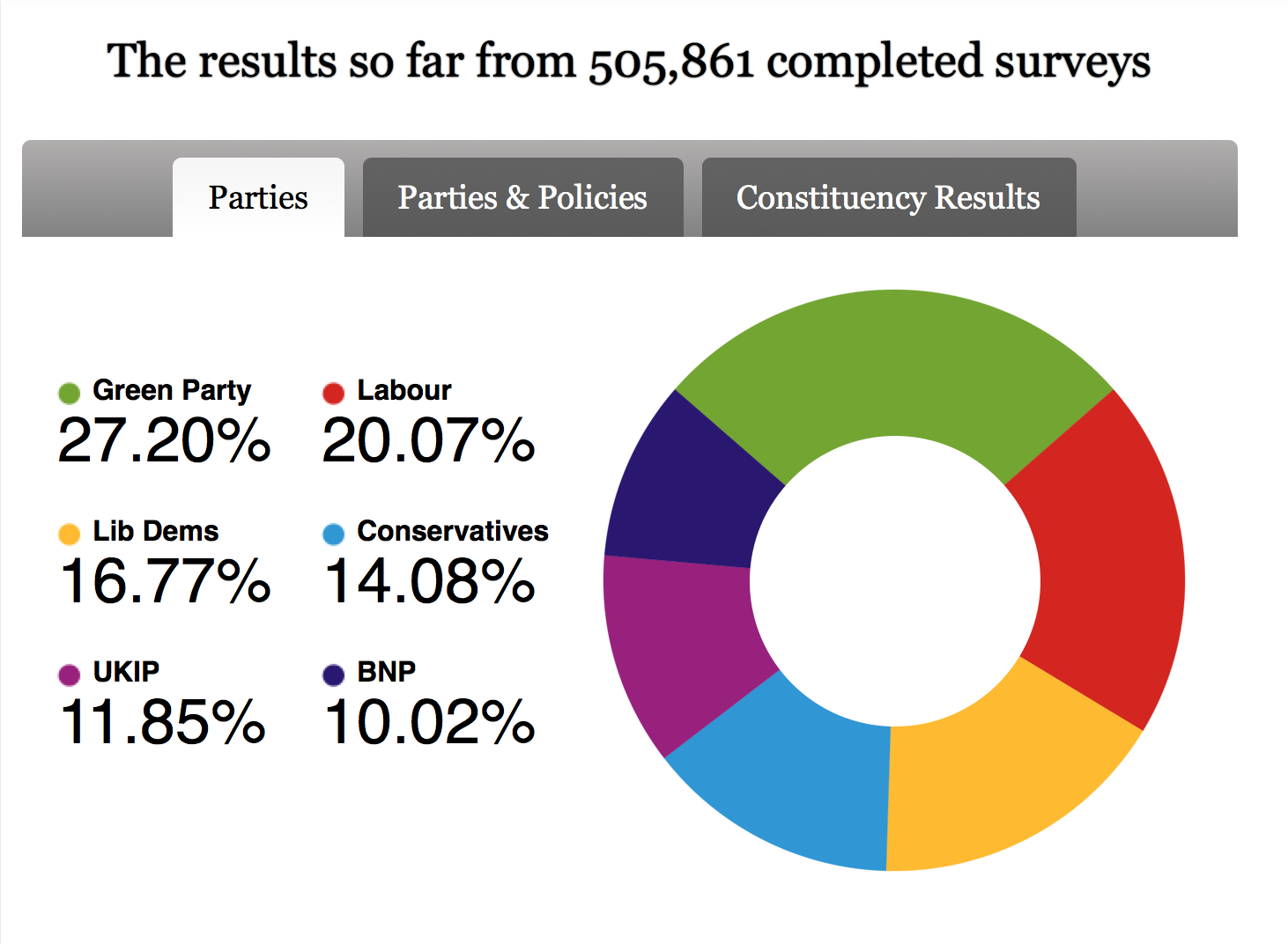
    The results are really well presented. There is a clear pie chart showing your overall breakdown. My result of 40% Green, 40% Labour and 20% Liberal Democrat was pretty much unchanged from my 2010 attempt.

    Underneath there is an option to enter an email address so be sent a link to your results and send a reminder on polling day. There are also the usual social media sharing options to spread the word. VfP are hoping for 5 million completed surveys this time around.

    In the final section the results are broken down by issue so you can see which party you voted for on which issue. This is where some of my results were a bit surprising. There was evidence of a left leaning consensus in my selections with variation at the level of implementation detail or phrasing rather than aspiration.

    Overall, and not surprisingly, I felt the Green Party were better at articulating a social democratic vision whilst Labour in particular was better at translating vaguer ambitions into something that could be implemented and might actually work. There are some sticking points, Trident being an obvious one, but I finished feeling optimistic about the prospects of a leftish coalition and wondering yet again why the Liberal Democrats are members of the current coalition.

    In fact, I would probably prefer a left leaning coalition with a broader spectrum of policies than perhaps a majority to better provide a mix of head, heart and soul. Certainly I think the Green surge, and to be fair the emergence of UKIP, is widening the Overton window and that is welcome.

    The results are also then shown for my constituency where 61 surveys have currently been completed and nationally where 47,000 have currently been completed. I won’t say much about these results yet to prevent influencing those yet to take the survey but the results are still looking strange. I still have my reservation from my 2010 attempt about the demographic sample of this kind of tool:

    An online tool like this appeals only to a minority of voters in certain demographics. There is no demographic breakdown for the constituency or overall responses. Those advocating the tool are likely to be tech-savvy, media literate and used to obtaining their information from diverse sources. Do these really represent the core voters who turn out and decide elections?

    Policy Browsing

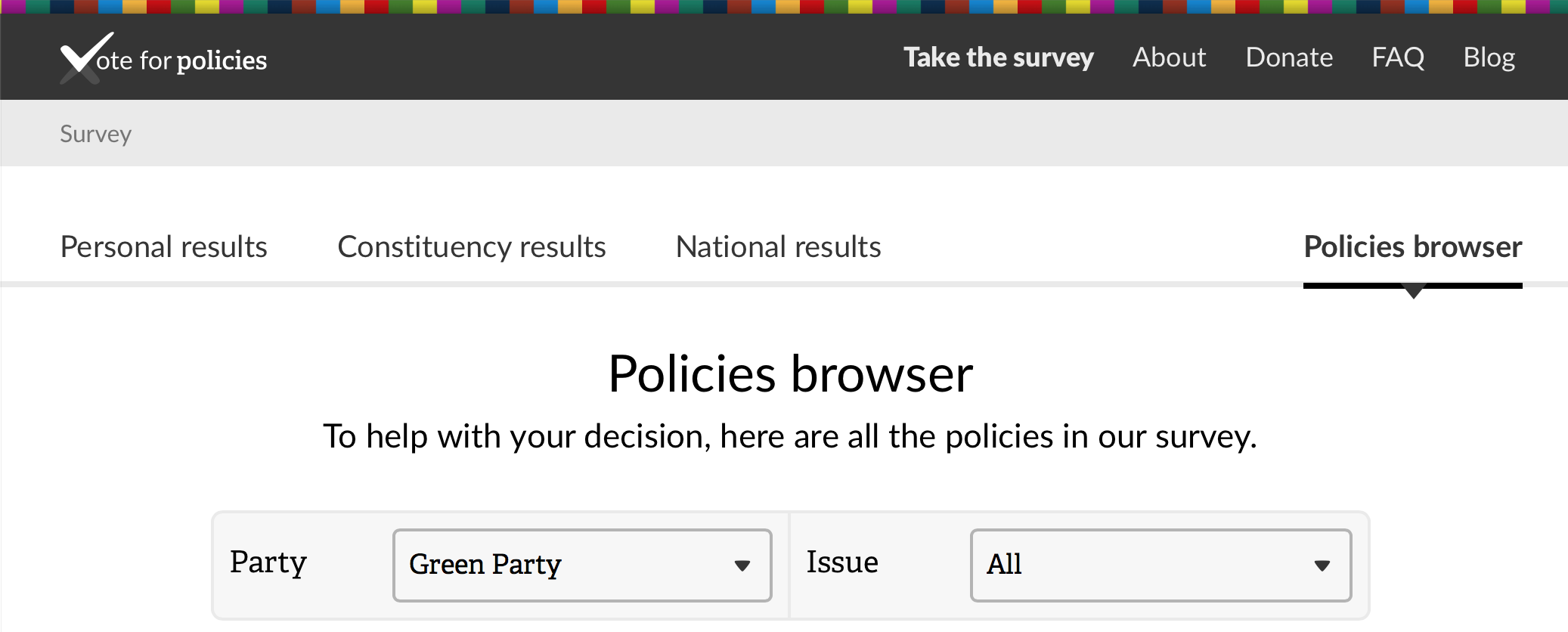
    A welcome addition is a policies browser. This allows you to go back and look at all policies again, this time knowing which policies belong to which party. This allows a more reflective look at all the policies for a party or to compare policies by issue. The browser also shows which policies you voted for. There is no login for the site which suggests this information using cookies and local storage to remember your participation. If you attempt to start the survey again then the site prompts that you have already completed and provides a link to your results (the same permalink as used when sharing). However it does also give an option to forget you, suggesting you can erase the memory of your previous attempt and have another go. Not clear if you do this whether your previous result will be erased from constituency and national results or not or whether you could complete multiple attempts all adding to the overall verdict. It is this question that makes me have reservations about using any results as campaign leverage.

    Summary

    Overall I think the site itself is much improved and I do hope it will be successful in introducing policies and a more thoughtful reflection on their voting preference to as many people as possible. Caveats still remain about its use as evidence.

    Pros

    • Clear and easy to use
    • Like introduction of shortlisting stage to quickly eliminate some policies
    • Result presentation much improved
    • Addition of the policy browser makes it easy to compare all parties across an issue or see all policies for a party to better review/reconsider after taking the initial survey
    • Don’t get to see national and constituency results until taken the survey preventing influence

    Cons

    • Still possibly open to gaming results so still a better tool for individuals rather than evidence of voting intention.
    • Still too easy to identify policies for some parties because of their distinctive language and policies. The editorial/neutrality conundrum is not yet resolved

    Vote for Policies

    Vote for Policies is a site that aims to extract party policies from the personalities and rhetoric of the surrounding campaign and lay them out next to each other so voters can really focus on the issues that matter to them. They claim it helps make “an informed, unbiased decision about who to vote for” for those who might want to vote with their head as much as their heart.

    How it Works

    A simple survey allows voters to compare policies for issues they select. At the end of the survey the results will show which party’s policies you most agree with both overall and broken down by each issue. You can also see the overall results for your constituency.

    How it is Funded

    The site is run by volunteers and aims to be neutral and objective. It is funded using crowdsourcing via donations. It was created for the 2010 General Election and over 500,000 surveys have been taken so far. For the May 2015 General Election they are aiming for over 5,000,00

    Trying it Out

    It’s worth noting that presently the site remains the one created for the 2010 election. This means the policies are not current and the parties represented do not represent current developments of the major Scottish, Welsh and Northern Ireland parties. The site is being updating for 2015 and a new mobile friendly version with updated policies and parties is due in February.

    I decided to try the current version out to see my current starting point and outlook based on the 2010 policies.

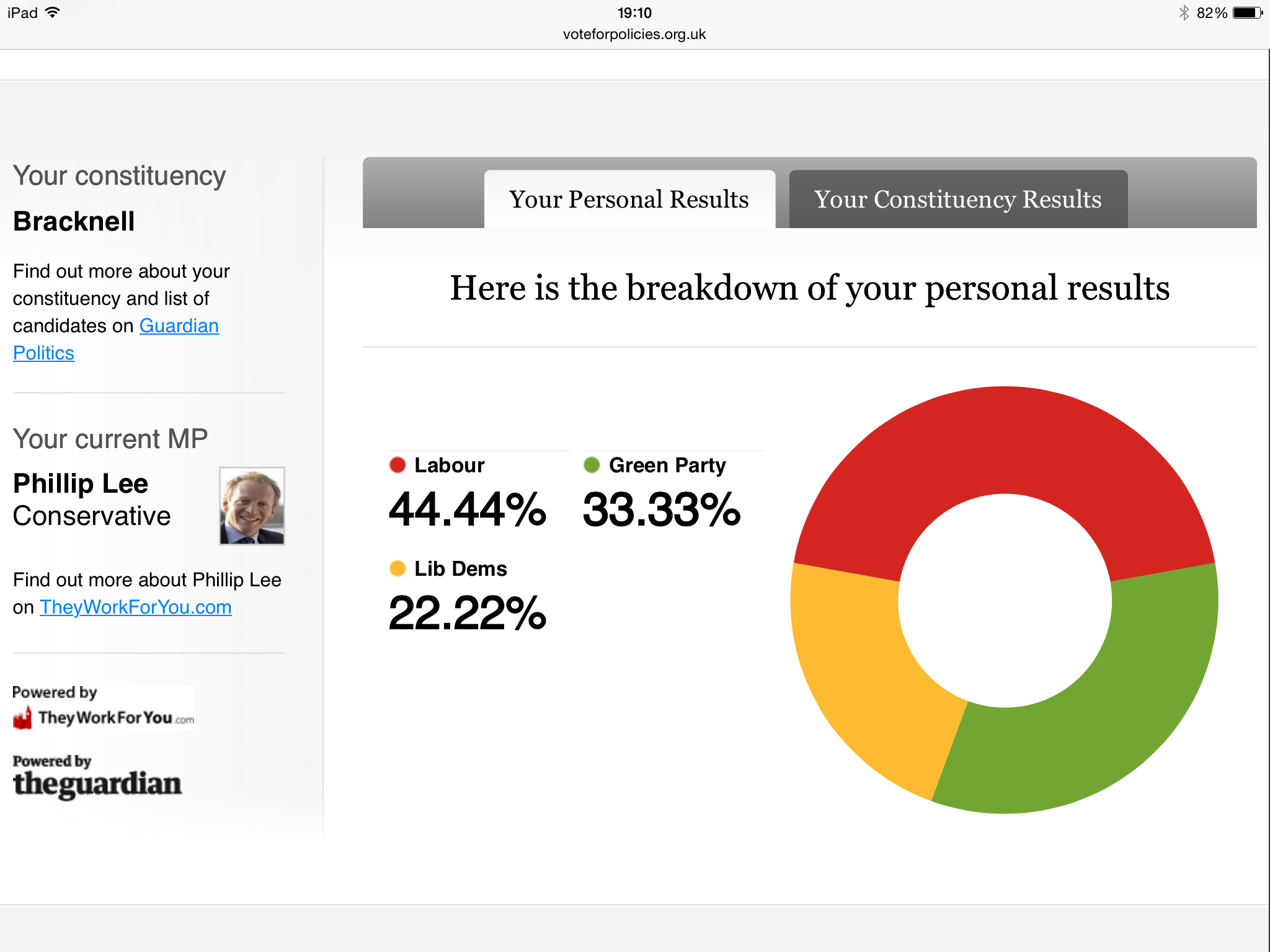
    I tried out every issue and at the completion of the survey my doughnut chart revealed I was 44% Labour, 33% Green and 22% Liberal Democrat. This isn’t really surprisingly as it reflects many of the starting views I’ve outlined and accurately reflects how I voted at the last election and elections since then.  This is where I would expect to be or at least to have been in 2010.

    2015-01-18 19.10.07This is not too dissimilar to my constituency picture with Labour, Green and the Liberal Democrats followed by the Conservatives and UKIP.

    2015-01-18 19.10.18Which is nothing like how the constituency voted in 2010 or indeed in my living memory.

    Source: Guardian

    Source: Guardian

    What Does this Tell Us?

    It is not surprising that leftist advocates will happily point to vote for policies as a better way of deciding on your vote. The overall position consistently puts the Greens, Labour and the Liberal Democrats ahead and recently the Greens have surged. Many suggest this is indicative of the current green surge and whilst I’d like it to be so I’m not sure about using the data so uncritically. The picture for my constituency is totally at odds with what happened.

    Some possible reasons for the difference and reasons to use Vote for Policies with caution include:

    • voters only discovered Vote for Policies after the 2010 election and had they had tools to help them separate the policies from the personalities they may have voted differently?
    • Vote for Policies is seen as interesting but mostly a bit of fun and established media and campaigns have much greater influence in voter decisions.
    • The sample size is small. Vote for Policies didn’t reach that many people previously but may play a bigger role in the coming 2015 election.
    • An online tool like this appeals only to a minority of voters in certain demographics. There is no demographic breakdown for the constituency or overall responses. Those advocating the tool are likely to be tech-savvy, media literate and used to obtaining their information from diverse sources. Do these really represent the core voters who turn out and decide elections?
    • The algorithm for calculating scores is only simply described on the FAQ page and is quite simple. Is this kind of averaging the best way to represent choices.
    • As far as I can see there is nothing to prevent people ‘gaming’ the system.
      • In some cases it is blatantly obvious which party is which. The policies are compiled without editing except to remove party names. This is admirable as editing brings its own problems but different parties have quite distinctive language. Their rhetoric is still discernible in their policies even out of context. More neutral language would make it harder to distinguish part policies by their language. Given this someone could go through and simply vote for the policies they recognise from their party rather than make an “informed, biased choice”.
      • There is nothing as far as I can see to stop people completing the survey multiple times to influence the results.

    I also found it interesting to note that not everyone taking the survey is examining every issue. The issues that voters are selecting may tell us something about priorities with Health/NHS top with 404.2K votes followed by Education (392.1K) and the Economy (379.6K). Europe is least voted on (258.6K) so perhaps these agonised debates about the European Union have undue prominence. Bearing in mind the caveats above there are still little vignettes to chew over such as the Liberal Democrats leading on Democracy and reflecting on the possibilities for democratic reform they have squandered this parliament.

    Going Forward

    Whilst I want the Vote for Policies outcomes to be truly representative of how people would vote if they focused more on policies I am concerned that it’s not enough to hold up data that reflects your point of view and use it uncritically as a campaigning tool.  Despite the prominence given to overall results on the site I’m also not sure this is the intended use of the tool.

    The current Vote for Policies results.  It looks good for the left but how representative is it?

    The current Vote for Policies results. It looks good for the left but how representative is it?

    There are too many caveats and questions about how the data is compiled. If Vote for Policies are hoping to be more powerful this time around, or at least tolerate use of their data for campaigning, they might need to address some of these and be more transparent about their data and maybe even open it up. Certainly if multiple survey completions by the same people can’t be prevented the data isn’t that representative generally and those using it as a kind of opinion poll should do so with caution.

    Where Vote for Policies works best is in the particular: as a useful tool for individuals that aids the engaged voter review, compare and contrast all policies on a particular issue in one place.

    Despite my reservations I do appreciate all the work the team behind Votes for Policies are putting in to help present information differently and making it simple and clear for voters to compare parties on key issues. I am looking forward to seeing how they refresh the site and the policies over the coming weeks.

    I will take the survey again once it has been revised to see how my views change and to critically appraise the update. I’ll also continue to keep an eye on the overall data and how people use both the tool and data during the campaign.

    Why Write a Political Blog?

    Simply because I wanted a space to engage more, think more and write more about social democratic politics. Because I want things to be different and that’s not going to happen unless people make it so.  I believe, rightly or wrongly, that the current parliament has been regressive for the country.  I think the left are better at managing the economy than common mythology has allowed and their policies are more effective than they have been given credit for.

    Telling Stories

    That is because politics is less about facts, less about the practical realities of ordinary lives and more about the subtle arts of persuasion: of being skilled at telling sublime stories, modern myths and the subtle rhetoric of making true become false and false become true.  It’s frustrating if you want politics to be about facts because political discourse allows for no such thing.  The facts are never allowed to speak for themselves and lies are encouraged to flourish.

    Instead you find yourself in a world where the 2008 financial crash is said to be caused by those who were least involved and have been punished mostly harshly by the outcomes.  You find those who gambled unwisely and took all the rewards carried no risk after all and continue thrive.  You see those who provided the assets to prop up the financial sector roundly criticised for their profligacy.  We will never know how a different government would have handled 2008 and what they would have done instead.  We will never know how an economy that was already recovering in 2010 would have mended under a different government to the one we got in 2010.  We do know the myths that have taken root to justify the blatant asset stripping of our state and subjugation of public sector and low paid workers.

    It is not enough to act.  It is not enough to cry unfair at blatant manipulation of the public record.  It is not enough to complain about the Fourth Estate without leveraging social media in response.  The left needs to find its voice and  add intellectual weight and articulate stories itself to advocate and argue for what the left does.

    Terrorism, Critical Theory and Politics

    Then there was the horrific criminal attack on the offices of Charlie Hebdo. The small-minded but deadly violence of that assault and related attacks was atrocious.  Such blatant acts of violence and criminality are easy to condemn.  There is no place for such assaults in our world.

    The debates about freedom and responsibility that have been unleashed are harder to comprehend and form a position on.  I have read many words about these attacks since that awful day in Paris and no doubt there are many more to come.

    Some represent extremist views from the full spectrum of political and philosophical dogmas but others have been complex and more nuanced. It’s been worrying how easy it’s become to use this assault on free speech to shut down divergent views and open debate with variants of the line “ah but whatever our faults we don’t react with an AK47”. Whilst true, this kind of absolutism disallows any form of self-reflection, critical thought or opportunity for any of us other than the perpetrators to reform.  The terrorists are not winning but neither are the disenfranchised.  There are unfortunately no easy and simplistic answers to many of these questions.

    I do know that to paint Western society as entirely perfect and liberal and Muslim society as entirely barbaric and conservative is the most ridiculously simplistic answer of all. All societies have their benefits, problems and violent outliers to different degrees. Different times suffer different wars. In our time many conflicts connect to Islamic insurgents though others don’t. I don’t pretend to understand the complexity of it all.

    One article in particular stuck with me and that was by Slavoj Žižek in the New Statesman

    In it he said:

    “it is the right moment to gather the courage to think

    He traces the faultlines or violent, radical Islam and liberal Western responses through critical theory finally settling on Walter Benjamin to tie the failure to mobilise dissatisfaction in more constructive progressive ways to a failure of the Left to lead that way.  Instead conservative voices, opportunist demagogues and violent radicals are seizing on dissatisfaction full not just of “passionate intensity” but also passionate insecurity.

    Now you may not agree with his argument that the difference between permissive liberalism and Islamic fundamentalism is but the latest false dichotomy: false because they are both reactions to the same dissatisfaction and reactions to each other.  They cannot exist without each other.  You may also not agree with his view that “those who do not want to talk critically about liberal democracy should also keep quiet about religious fundamentalism”.   I however don’t wish to tolerate radical Islam but nor do I wish to use its presence as an excuse to avoid taking a critical look at my own society.

    Failings of the Left

    It’s all too easy to react furiously and to blame others if the world is not as you would like it but the first thing to do is examine yourself before tackling the incomprehensible. Change can only and always start with yourself.

    The rise of fundamentalist, perhaps violent, ideology of any variety will fill a vacuum left by the failure to offer any credible response to people who, rightly or wrongly, feel like they have a raw deal.

    It’s hard for me to say it but since the post-WWII settlement I think the radical, reformist Left’s intellectual hinterland and it’s political appeal has been slowly seeping away.

    The failure to change anything, anything, following the 2008 financial crash and the ability of others to turn that narrative into one of state spending culpability justifying unnecessary austerity and a vicious ideological slashing of the state that is iniquitous and damages whole swathes of our society is as big a defeat for social democracy as I’ve lived through.

    I stood by and let it happen.

    It should be impossible for any left leaning pluralist to ignore the siren screams of discrimination, corruption and violent crime.  We won’t all participate in Politics on a grand stage but that doesn’t been we should abdicate our responsibilities to participate in our politics locally and/or and join debates about what is a better society, what is sustainable living in order to build it from the ground up. I believe that society and that lifestyle comes from social democratic politics so I should stand up for that.

    Stand Up and Be Counted

    The analysis on major parties by Ofcom showed that nor is it is not enough to have an opinion. You have to have an obvious and measurable opinion in the hyper mediated world. You don’t just have to stand up you have to stand up and be counted.

    Their analysis of current support uses only opinion polls not party membership. Their analysis of elections considers not just elected representatives but share of the vote. If that is the case then protest votes and tactical votes become invisible. No vote is ever wasted if it means more media recognition that alternatives exist and people are willing to vote for them. That told me it was not enough to be against what I disagreed with but I had to more obviously and actively be for what I believe.

    I certainly don’t agree the answer to disaffection with politics is to turn your back on it and not vote. If you don’t like it you have to do more. You can’t complain that all politicians are the same if you aren’t willing to represent difference.

    All this led me to believe, despite my misgivings, I should do something, however small, to be a more democratic and engaged citizen and to represent and advocate social democracy in public discourse. So this is a start.