So here we are. The United Kingdom has left the European Union, the joint political and governmental institutions of Europe. Accepting the reality of this situation is not the same as liking it.
It pains me that we have rejected principles of cooperation and mutualism. It annoys me that the left defended these principles so poorly and chose a more parochial oath. It bewilders me that a right that lauds our own union of nations and that of American states and a left that lauds unions and cooperatives as beneficial organising methods should both abandon a noble attempt to scale-up unionism as an alternative to warfare. It saddens me that for the first time in my life I woke up this morning with fewer rights than I had before. It concerns me I still don’t know what exactly those rights have been sacrificed for or what will gilt this heralded national golden age.
I remain a Brexitsceptic.
I hope to be proved wrong. I hope we succeed, despite my doubts, in thriving as an independent trading nation forging peace, prosperity and friendship with all nations. I’d happily be as wrong about Brexit as those doomsters and gloomsters who thought wind turbines wouldn’t pull the skin off a rice pudding were about our ability to generate renewable energy. I want to believe in the promise of great things to come but I need more substance to the optimism.
We remain though, European.
Not just geographically, but rooted in the fundamental and enduring values of liberty, equality and solidarity. Along with 46 other countries we are members of the Council of Europe, the organisation founded by the Treaty of London in 1949 to uphold human rights, democracy and the rule of law.
Today is both much the same and yet fundamentally different in as yet unseen ways. All these facts and feelings need to be wrangled into a new way of being.
So Long Status Quo
I’m someone who wants the EU to exist, wants to be part of it but also wasn’t entirely uncritical of it. Like any complex system its both good and flawed. Like many people I wanted the EU to become leaner, more democratic and agile albeit in unspecified ways. I was supportive of that journey even if fraught and slow and bedevilled by crisis. What large-scale project isn’t?
When the choice was between leaving and continuing our bespoke membership I found it easy to be a remainer.
I thought the UK’s bespoke membership was a good deal for us. Negotiated over decades it made the best of this all-round scepticism and has bought us a large measure of peace, prosperity and productivity for limited concessions. It was home. It was worth fighting for. We may find out we did indeed never have it so good.
However, when polled in the referendum, a majority, albeit slim, disagreed and were not persuaded that the benefits of membership outweighed the constraints. We have been negotiating the consequences of that mandate ever since and probably will be for many years to come.
During the Article 50 negotiating period I continued to argue for the merits of our existing deal by probing the suggested alternatives and pressing for a specific, single option to be compared with the status quo. For me the 2016 referendum was a matter of principles and I advocated for a second one to consider the practicalities. Given there is no recorded majority for any single option (leave encompasses several alternatives to membership), the unanswered question remains: what is the people’s second preference?
In a democracy, we contest then live with our collective decisions. Now the Article 50 process has concluded those arguments are moot, mute. A new phase begins.
Still, The Europe Question
This is a transformative moment for Europe too. Losing a member state for the first time, approaching the end of the stabilising Merkel era, grappling with the macro forces of migration, climate and technology, the destabilising geopolitics of Trump’s foreign policy, the threat of trade and information warfare along with Middle Eastern conflict and faltering neoliberalism and rising populism in political ideology.
The remaining members could find that the tensions of the EU’s murky statehood are unsustainable and unreconcilable. Does the EU represent a shared Europe or a single Europe?
The institutions of the EU are feeling the strain but they also have their own opportunity for renewal and redirection. There is a new Parliament and Commission and a new set of strategic priorities. I hope the EU finds a way towards social democratic principles and sustainability under the auspices of initiatives like the European Green Deal.
Like it or not, these are no longer questions for us but they remain inherent in the European Union project.
Given our ambiguous position a stark choice between europhilia (ever closer union) and hard euroscepticism (complete exit from EU jurisdiction) perhaps had to be faced but was in fact never even on the table in the referendum debate of the last three years (as far as I’m aware remainers were campaigning for the status quo or evolutionary reform not a switch to standard EU membership).
I’m not entirely sure what I would choose if being British European meant opting form standard membership rather than continuing to muddle along as we were. We’ve always been bespoke European, not all-in. Brexit has made it clear that many people choose sovereignty even over economy. That’s why I find it hard to see a movement to rejoin any time soon as surely that way both greater pressure towards standard membership and fraught debates on the EU’s direction of travel lie. Finding a UK majority for that is I suspect a long time and/or a lot of pain away.
The campaigns of the last three years have been about getting Brexit done, not about what comes next. The referendum of 2016 set the course to this point but it neither asked what should come next nor decided on the alternative(s) to EU membership. We’ve effectively ruled out three options but haven’t definitively decided on a way forward yet though the likeliest is some form of bilateral agreement.
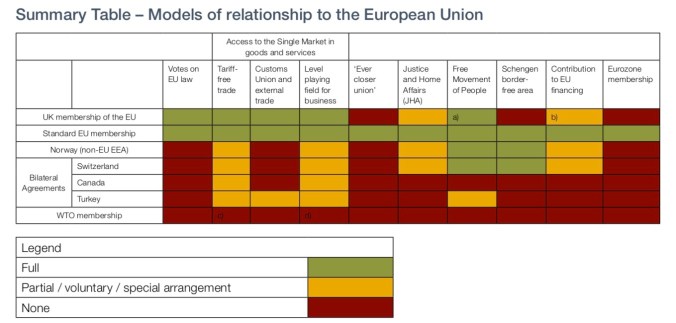
This next stage, negotiating a new British and Northern Irish identity, a new way of operating and new ways of trading internationally begins now and will take years to complete and is without a definitive mandate. This is the debate we move onto and it’s one that doesn’t belong to leave or remain, but to all of us.
With the first two of these models, those concerning varieties of EU membership, now firmly ruled out, fulfilling the 2016 referendum mandate, the question remains which of the alternatives should, will, form the basis of the future relationship with Europe? We face months, maybe years, having done Brexit but still debating the ‘reverse Swiss’ or the ‘Canada plus’ or the ‘cliff edge’ of no-deal. The people now have no say; the Government will decide.
They have to figure out what a new relationship with Europe looks like, how that fits with other trading opportunities and how to fairly share the costs and benefits of this path. This will take long and painstaking diplomacy and a period of adjustment. The trade offs and tough decisions involved haven’t gone away just because the bells tolled (or not) on Brexit day.
Replacing EU, So Much To Do
I’m not going to stop stop challenging the assumptions, policies and tactics of Brexit as a strategy or the Government’s delivery, probity and integrity just because we’ve reached the implementation stage. It’s even more important to do so now. After all we have so much to do now to make this work and there’s only the sketch of a plan.
The recent triumphalism seems premature when not only do we need to replace all that our EU membership provided, the trade, the science, the security, the structural funding, but there is the pressing domestic agenda needed to repair a crumbling public realm neglected by austerity in order to provide homes, jobs, education, opportunity and care more equitably along with levelling up regionally and economically and sharing the Brexit dividend around fairly.
The New Conservatives now in Government have to move on from the slogans and nail the specifics to deliver on all its promises for this so-called golden age. We can help but they must lead and act on their words. No excuses. No evading scrutiny.
It’s tempting for those of us who think this is the wrong course of action to continue to protest, look for the worst and stand like a chorus of Cassandras as the country moves on. I think this would be a mistake. Given we cannot prophecy the future it risks chauvinism when we need stoicism. Our critique needs to be pertinent not petty. We need to participate not just protest and do our best to both guard against hubristic jingoism and make sure our own misrerabilist predictions don’t become a reality.
We need to help forge this new place in the world if we want it to be something we can celebrate. We have to push for close partnership with our European neighbours based on our common values and objectives whilst exploring new opportunities elsewhere. Find ways to continue to be bespoke Europeans, members of the Commonwealth, global operators and distinctively, proudly British.
Above all we need to focus ruthlessly and relentlessly on what really matters: that people get the homes, sustenance, work, environments, communities and care they need in ways that are respectful to all the life our planet sustains.
Seizing the Opportunity
After all neither Brexit or EU membership are ends; they are means.
Systems thinking leads to another conclusion, however, waiting, shining, obvious, as soon as we stop being blinded by the illusion of control. It says that there is plenty to do, of a different sort of “doing”. The future can’t be predicted, but it can be envisioned and brought lovingly into bring. Systems can’t be controlled, but they can be designed and redesigned. We can’t surge forward with certainty in a world of no surprises, but we can expect surprises and learn from them and even profit from them. We can’t impose our will on a system. We can listen to what the system tells us, and discover how its properties and our values can work together to bring forth something better than could ever be produced by our will alone. We can’t control systems or figure the out. But we can dance with them.[^1]
The means may have changed but the ends of liberal, ethical and social democracy remain the same: a society that is free, fair, equal and sustainable
However way you look at Brexit this is a transformative moment for our country. Such moments are disruptive but also provide the opportunity for radical renewal. We shouldn’t cede that ground. We can use this moment to regenerate, innovate and lead the way towards a new political economy that finds prosperity and peace in being socially just and ecologically sound.
These goals remain as important today as they were yesterday. So we have to roll up our sleeves, elbow our way into mapping out this new direction and change the narrative.
References
[^1] Donella Meadows, Thinking In Systems. 2008. pp. 169-170
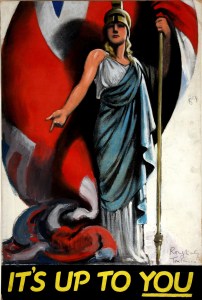
Cover Image: Britannia by Tom Purvis


 GreenFinch Song
_Artist_Tom_Purvis.jpg)
